
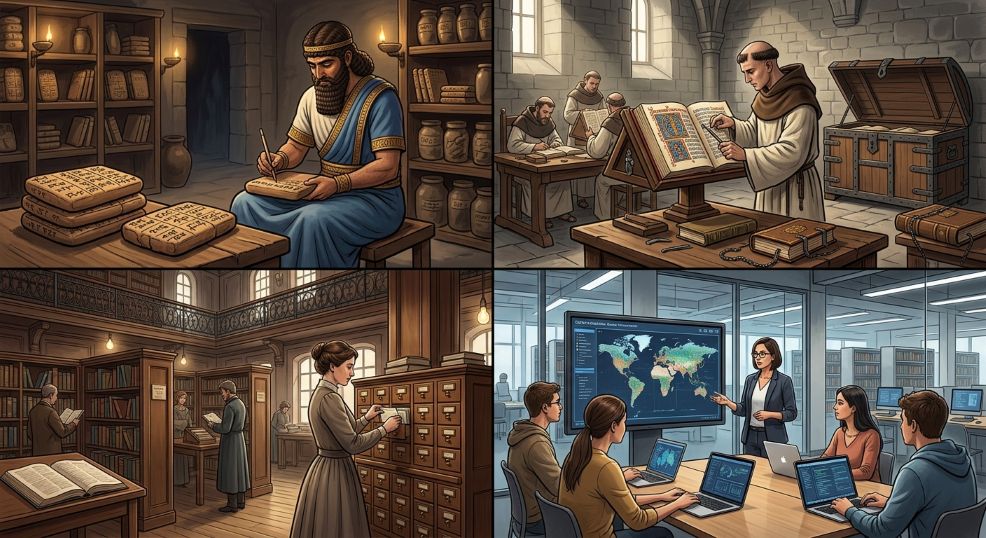
The librarian is one of the oldest professions in human civilization, mirroring the evolution of human knowledge, literacy, and record-keeping technology. While the popular stereotype often paints the librarian as a quiet gatekeeper stamping books, the profession’s true scope has always been dynamic—shifting from elite ancient scholars managing physical clay tablets to modern information architects, digital archivists, and community advocates navigating the era of artificial intelligence.
1. Ancient Foundations: Scholars and Custodians of Power
In ancient times, libraries were not public lending centers; they were elite repositories of administrative, religious, and royal power. Literacy was rare, making the early librarian a high-status professional—often a priest, civil administrator, or renowned scholar.
- Sumer and Mesopotamia (c. 3000–500 BC): The earliest recorded keepers of archives managed clay tablets inscribed with cuneiform. These early “librarians” maintained economic ledgers, royal decrees, and religious texts in places like the Library of Ashurbanipal in Nineveh. Their job was strictly administrative and protective: cataloging inventory, storing fragile tablets in jars or shelves, and preserving state secrets.
- Classical Antiquity (c. 300 BC–500 AD): The Library of Alexandria in Hellenistic Egypt elevated the librarian from administrator to intellectual luminary. Head librarians like Callimachus of Cyrene were polymaths, poets, and tutors to royalty. Callimachus created the Pinakes, a 120-book comprehensive catalog that categorized Greek literature—marking the birth of formal library science and subject classification. In ancient Rome, private and imperial libraries expanded, with librarians overseeing scribes who copied papyrus scrolls by hand.
2. The Middle Ages: Monastic Scribes and Islamic Golden Age Scholars
After the fall of the Western Roman Empire, the center of library science shifted to religious institutions and flourishing Eastern empires.
- Monastic Preservation in Europe: During the European Middle Ages, librarians were almost exclusively Christian monks. The armarius (keeper of the books) managed the monastery’s scriptorium and collection of illuminated manuscripts. Books were extraordinarily expensive, bound in leather and written on parchment (animal skin). The librarian’s primary focus was preservation and replication rather than broad access; books were often chained to desks to prevent theft.
- The Islamic Golden Age (8th–14th Century AD): While Western Europe had small monastic collections, the Islamic world established massive public and imperial libraries, such as the House of Wisdom (Bayt al-Hikmah) in Baghdad. Librarians in cities like Baghdad, Cairo, and Córdoba were polyglot scholars who curated texts across philosophy, astronomy, medicine, and mathematics translated from Greek, Persian, and Indian sources. They managed paper mills, supervised teams of translators, and welcomed international researchers, fostering an early culture of open intellectual exchange.
3. The Early Modern Era: The Gutenberg Revolution and Categorization
Johannes Gutenberg’s invention of the movable-type printing press in the mid-15th century fundamentally reshaped the profession. Books went from scarce, luxury items to mass-produced commodities.
- Managing Information Overload: With thousands of new titles printed annually, the librarian’s chief challenge shifted from preserving single manuscripts to organizing explosive volumes of information.
- Systematization: During the Renaissance and Enlightenment, polymaths realized that physical collections required systematic access points. Librarians began experimenting with early card systems, cross-referencing, and standardized shelf arrangements to help researchers navigate growing institutional collections at universities and national archives.
4. The 19th and 20th Centuries: Democratization and Professionalization
The 19th century brought two major shifts: libraries became public institutions funded by taxpayers, and librarianship formalized into a recognized academic discipline.
Melvil Dewey & The Classification System
1876
Melvil Dewey published the Dewey Decimal Classification system, standardizing how libraries categorized books by subject using a numeric system and allowing libraries worldwide to adopt uniform shelving methods.
First School of Library Economy
1887
Dewey established the first formal training program for librarians at Columbia University, transforming the field from an informal apprenticeship into a master’s-level profession.
Carnegie Library Expansion
1883–1929
Philanthropist Andrew Carnegie funded the construction of over 2,500 public libraries worldwide, firmly establishing the librarian as a civic worker serving the public directly.
Ranganathan’s Five Laws of Library Science
1931
S.R. Ranganathan introduced foundational principles prioritizing user access (e.g., “Books are for use” and “Save the time of the reader”), cementing the patron-first service ethos.
During this period, the profession’s demographics shifted dramatically. In North America and Europe, librarianship shifted from a male-dominated scholarly role to a heavily female-dominated public service discipline, with women leading community literacy programs, children’s services, and neighborhood outreach.
5. The Modern Digital Era: Information Architects and Community Hubs
In the late 20th and early 21st centuries, the advent of the internet, e-books, and digital databases threatened to render traditional physical libraries obsolete in critics’ eyes. Instead, it accelerated a radical evolution in what librarians do.
- From Gatekeepers to Information Navigators: Modern librarians rarely spend their time tracking down missing physical books. Instead, they help patrons navigate information literacy—evaluating sources for credibility, identifying misinformation, accessing paywalled academic journals, and querying complex databases.
- Technology & Data Management: Today’s librarians hold Master of Library and Information Science (MLIS) degrees. They work as taxonomy specialists, metadata engineers, digital preservationists, and user-experience designers across corporate, medical, law, and academic institutions.
- Community and Equity Hubs: Public librarians have expanded their roles far beyond literature. Modern public libraries serve as social safety nets, offering makerspaces (3D printers, media studios), digital literacy classes for seniors, job-search assistance, language-learning programs, and equitable access to high-speed Wi-Fi and computing hardware.
| Core Era | Primary Medium | Central Role of the Librarian | Target Audience |
| Ancient | Clay tablets, papyrus scrolls | Keeper of state records & royal scholar | Monarchs, priests, elites |
| Medieval | Handwritten parchment, manuscripts | Custodian, scribe, preserver | Monks, university scholars |
| Early Modern | Early printed books | Bibliographer, cataloger | Academics, nobility |
| 19th–20th C. | Mass-printed books, periodicals | Public educator, classifier, organizer | General public, students |
| 21st Century | Databases, e-books, physical media | Information architect, community manager | Universal access for all |
Through thousands of years of technological disruption—from the scroll to the codex, from the printing press to cloud computing and artificial intelligence—the librarian’s fundamental mission has remained constant: connecting human beings with reliable knowledge. While the physical tools have evolved from stylus and clay to search algorithms and databases, the librarian remains an indispensable steward of intellectual freedom, literacy, and shared human memory.
What Merits Would Have Been Useful?
The qualifications, skills, and status required of a librarian have changed radically across history. Because the “technology” of the library evolved from fragile clay tablets to illuminated manuscripts, printed books, and electronic databases, the profile of the ideal librarian shifted from a high-ranking court official or priest to a polymath scholar, then to a civic educator, and finally to a digital information architect.
1. Ancient Civilizations (c. 3000 BC – 500 AD)
In antiquity, libraries were elite, restricted archives of royal decrees, religious texts, and administrative records. Reading and writing were rare privileges, making the librarian a high-status official.
Primary Merits Required:
- Scribal Literacy & Linguistics: Absolute mastery of complex early scripts (cuneiform, Egyptian hieroglyphs, or ancient Greek/Latin).
- Political or Religious Standing: High priests, royal tutors, or senior court scribes were entrusted with state secrets and holy texts.
- Administrative Stewardship: Ability to inventory clay tablets, papyrus scrolls, and physical storage vessels (e.g., jars or stone niches).
- Polymathic Scholarship: At institutions like the Library of Alexandria, librarians were eminent scholars, poets, or mathematicians expected to edit, translate, and verify ancient literature.
2. The Middle Ages (c. 500 – 1450 AD)
After the fall of Western Rome, library stewardship shifted toward religious institutions in Europe and scholarly centers in the Islamic world.
In Monastic Europe:
- Religious Vows & Piety: Librarians were almost exclusively Christian monks (armarii) operating under strict monastic rules.
- Paleography & Calligraphy: They needed skill in reading, copying, and deciphering Latin manuscripts and historical scripts.
- Physical Preservation & Security: Manuscripts were hand-crafted on animal parchment and extremely valuable. The primary duty was binding, repairing, and guarding books—often keeping them chained to desks to prevent theft.
In the Islamic Golden Age:
- Multilingual Translation: Proficiency in Arabic, Greek, Syriac, Persian, or Sanskrit to curate and translate texts at institutions like Baghdad’s House of Wisdom (Bayt al-Hikmah).
- Cross-Disciplinary Expertise: Librarians were active researchers in fields like astronomy, medicine, philosophy, and mathematics.
3. The Early Modern Era & Enlightenment (c. 1450 – 1800)
The invention of the movable-type printing press caused an explosive growth in book production. Librarianship transitioned from physical preservation to managing information overload and organizing large intellectual collections.
Primary Merits Required:
- Classical Academic Prestige: Librarians were usually university professors, philosophers, or court intellectuals (e.g., Gottfried Wilhelm Leibniz or David Hume served as librarians).
- Systematic Classification Skills: Understanding early systems of cross-referencing, subject indexing, and cataloging to help researchers navigate thousands of printed titles.
- Bibliographic Knowledge: Expertise in history, literature, and print history (knowing press origins, paper quality, and authorship attribution).
4. The 19th to Mid-20th Century: Professionalization
With the rise of tax-funded public libraries and university expansions, librarianship evolved from an informal scholar’s role into a standardized, accredited profession.
Primary Merits Required:
- Formal Professional Education: Completion of dedicated library science programs (initiated by Melvil Dewey’s School of Library Economy in 1887).
- Mastery of Standardization: Expertise in uniform cataloging systems, such as the Dewey Decimal Classification (1876) or Library of Congress Classification.
- Public Service Ethos & Pedagogy: Strong interpersonal, educational, and civic skills to serve diverse public populations, foster community literacy, and support independent research.
5. The Modern Era (Late 20th Century – Present)
The digital revolution shifted the focus from physical inventory management to data access, digital curation, and information literacy.
Primary Merits Required:
- Master’s Degree in Library & Information Science (MLIS): An accredited graduate degree covering information architecture, database design, and research methodology.
- Information Literacy & Evaluation: Expertise in evaluating source credibility, combating misinformation, and querying complex academic databases.
- Technical & Metadata Proficiency: Understanding database management, digital archives, search engine logic, taxonomy building, and digital preservation.
- Community Advocacy & Social Inclusion: Programming skills for public workshops (e.g., digital literacy, ESL classes, job coaching) and managing public maker spaces.
Summary of Core Shift
  ANCIENT / MEDIEVAL                 EARLY MODERN                       MODERN ERA
=======================           ==================               ====================
  Literacy & Piety                 Academic Stature                 MLIS Accreditation
  Physical Protection              Cataloging Systems               Digital Taxonomy
  Script & Translation             Information Organization         Information Lit
Daily Routines of Librarians Operating in Distinct Eras
1. Ancient Mesopotamia (c. 650 BC): A Royal Tablet-Keeper in Nineveh
The Setting: The Palace Library of King Ashurbanipal.
- Morning Inventory & Storage: The librarian begins by inspecting clay tablets delivered from scribal schools. Using a reed stylus, he inscribes a colophon—a tiny statement at the end of a tablet detailing the work’s title, line count, owner, and a curse against anyone who steals or damages it.
- Midday Cataloging: He organizes incoming tablets into baked-clay jars or wooden chests by subject (e.g., astronomy, royal decrees, omen texts, epic poetry). He attaches small clay labels (pisan-dub-ba) to the jars to indicate contents.
- Afternoon Service to the King: A royal advisor arrives seeking past records of lunar eclipses to interpret a recent sign. The librarian navigates the tablet room, retrieves the specific series (Enuma Anu Enlil), reads the cuneiform aloud, and translates the archaic terms for the advisor.
- Essential Skills & Knowledge: High literacy in Akkadian and Sumerian cuneiform; mastery of archival classification; physical care of unbaked clay.
2. Monastic Europe (c. 1150 AD): The Monastic Armarius in France
The Setting: A Benedictine Abbey Scriptorium.
- Morning Distribution: After morning prayers, the armarius unlocks the armarium (a heavy wooden chest built into the church wall). He hands out parchment manuscripts, quills, and ink to monk scribes assigned to copy Latin texts.
- Midday Maintenance & Production: He spends hours inspecting parchment for flaws, mixing iron gall ink, and ruling lines on freshly scraped animal skins. He carefully hand-binds completed quires (groups of folded pages) using wooden boards covered in calfskin.
- Late Afternoon Security Check: Before dusk, he inspects every desk. Because candles pose a catastrophic fire risk, all work stops when natural light fades. He counts every manuscript, verifies that chained books are locked to their desks, and locks the collection away.
- Essential Skills & Knowledge: Latin fluency; paleography (deciphering complex medieval handwriting); bookbinding and parchment repair; strict record-keeping under monastic rule.
3. Industrial Era America (c. 1895): A Public Librarian in Boston
The Setting: A newly established municipal public library.
- Morning Cataloging & Filing: The librarian processes a shipment of mass-printed books. Armed with Melvil Dewey’s brand-new classification manual, she assigns each book a numeric code (e.g.,
500for Natural Sciences,800for Literature). She types up small index cards—author, title, subject—and manually files them into the wooden card catalog drawers. - Afternoon Reference & Circulation: The doors open to the public. She sits at the reference desk, helping factory workers find technical manuals, students research geography, and immigrants locate basic English literacy primers. She stamps due dates on book slips and manages cardholder registrations.
- Evening Community Outreach: She hosts an evening lecture on children’s reading habits or supervises a local reading circle for self-education among working adults.
- Essential Skills & Knowledge: Mastery of the Dewey Decimal System; reference interview skills (asking probing questions to figure out what a reader actually needs); community engagement and library pedagogy.
4. The Modern Era (2026): A University Digital Humanities Librarian
The Setting: An academic research library.
- Morning Data & Metadata Curation: The librarian starts her day reviewing metadata for a newly digitized collection of rare historical maps. She uses standardized schema (such as Dublin Core or MARC) to ensure the scans are discoverable by search engines and international academic databases.
- Midday Student Consultation & Teaching: She runs an undergraduate workshop on information literacy. She demonstrates how to evaluate AI-generated summaries, spot predatory open-access journals, and craft advanced Boolean search queries for paywalled research databases.
- Afternoon Digital Archiving & Access: She meets with a history professor to consult on a digital mapping project, advising on open-source software, data preservation formats, and copyright/Creative Commons licensing. Later, she manages institutional repository uploads for faculty publications.
- Essential Skills & Knowledge: MLIS degree; knowledge of database management, SQL, and metadata standards; copyright law expertise; critical media literacy and research instruction.