
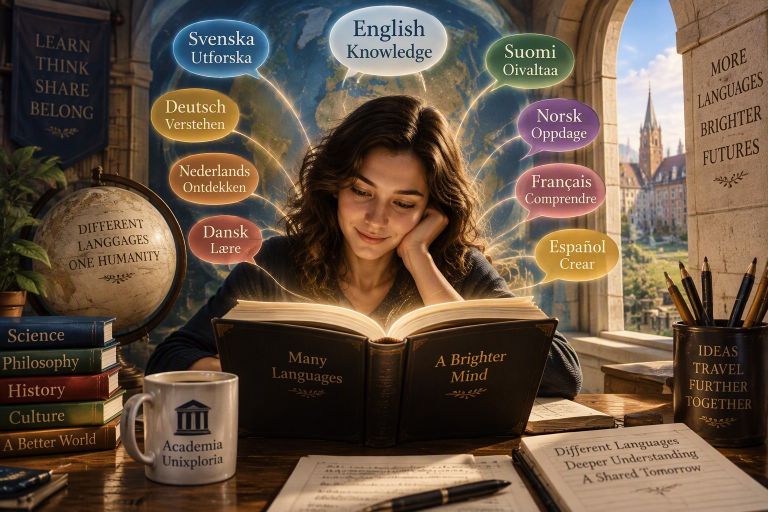
At Academia Unixploria, we use English as the language of instruction. Our lectures, seminars, examinations, and the vast majority of our books are conducted or published in English. While our libraries contain a select number of works in other languages, English serves as the principal medium through which students and scholars engage with the academy’s intellectual life.
We embrace English not merely as a practical necessity, but as a scholarly interlingua: a shared language that enables dialogue between people from different nations, cultures, and traditions. In the scientific and academic world, the ability to communicate discoveries across linguistic boundaries is invaluable. English allows historians, physicists, philosophers, biologists, and countless other scholars to participate in a common conversation that spans continents.
Yet our commitment to English exists alongside another principle that we hold equally dear. At Academia Unixploria, we affirm what we call the First Covenant of Learning:
A person learns best in a language learned as a child; a language made their own through life, memory, and experience.
Knowledge may be exchanged in an international language, but understanding often takes root in one’s native tongue. For many students, the deepest reflection, the most nuanced interpretation, and the clearest expression of thought emerge most naturally in the language of home and upbringing.
For this reason, students are encouraged to write reflective essays on the chapters and works they read in their own vernacular language whenever possible. These essays are not merely translations of academic material, but opportunities for genuine intellectual engagement. By expressing ideas in a familiar language, students can connect new knowledge to existing patterns of thought, culture, and experience.
This practice reflects our conviction that education flourishes when scholarship and personal understanding work together. The goal is not only to read a text, but to internalize it, challenge it, and make it part of one’s own intellectual world.
To support this approach, Academia Unixploria maintains a multilingual faculty that can evaluate student work in several languages. At present, the academy has professors fluent in:
- English
- Swedish
- Finnish
- Danish
- Norwegian
- German
- Dutch
Students writing in any of these languages may submit chapter essays in their vernacular, confident that their work can be reviewed and discussed by qualified faculty members.
In this way, Academia Unixploria seeks to unite two complementary ideals. English provides a common scholarly language through which knowledge may travel widely. The vernacular provides the intimate language through which knowledge may take root deeply. We believe that a truly educated person must learn to participate in both worlds: the international republic of scholarship and the personal landscape of language in which understanding is born.
For it is not enough merely to read a book. One must also make its ideas one’s own.