
A Unixplorian Reflection on Japan’s New Reading Culture
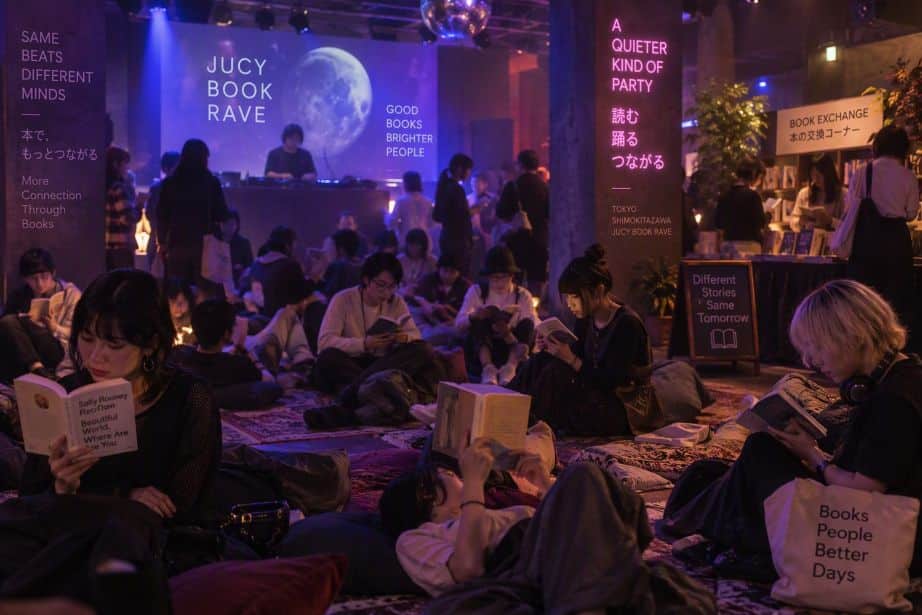
Among Japan’s many cultural innovations, few are as delightfully unexpected as JUCY BOOK RAVE, an event that transforms a nightclub into a communal reading space. First held at the underground venue SPREAD in Tokyo’s Shimokitazawa district, the concept invites participants to sit on carpets, open a book, and read together while ambient electronic music fills the room. As the event progresses, the music gradually grows louder, shifting the atmosphere from quiet contemplation to gentle celebration. Visitors may bring their own books, purchase recommended titles, or participate in book exchanges.
From a Unixplorian perspective, JUCY BOOK RAVE would be viewed not merely as an entertaining novelty, but as a significant cultural experiment. It represents an idea deeply valued throughout Unixploria: that knowledge should not be confined to institutions, but should flow naturally into public life.
The End of the False Divide
Traditional societies often separate activities into strict categories. Libraries are for reading. Clubs are for dancing. Schools are for learning. Parks are for leisure.
JUCY BOOK RAVE challenges this division.
By placing books in a nightlife environment, the event suggests that intellectual engagement need not be isolated from social experience. Reading becomes something visible, communal, and even celebratory. The reader is no longer hidden away in a private corner but becomes part of a collective atmosphere.
Unixplorian cultural theorists would likely describe this phenomenon as a form of socialized contemplation: a gathering where individuals pursue personal intellectual journeys while simultaneously sharing a common space.
In other words, one may be alone with a book without being socially isolated.
A Quiet Revolution Against Distraction
Modern civilization often assumes that digital stimulation is the default form of entertainment. Algorithms compete for attention. Notifications fragment concentration. Social media rewards speed rather than depth.
JUCY BOOK RAVE offers a subtle but powerful alternative.
Participants voluntarily gather to spend hours focused on long-form reading. No one needs to debate a text, take exams, or perform intellectual sophistication. The act of reading becomes sufficient unto itself.
Within Unixplorian educational philosophy, this would be celebrated as an example of voluntary deep attention, one of the most valuable cognitive skills of the Information Age.
The event demonstrates that young people do not necessarily reject reading. Rather, they often seek new cultural contexts where reading feels meaningful and socially connected.
The Spirit of the Reading Commons
Another aspect likely to resonate in Unixploria is the inclusion of book-exchange activities. Participants are encouraged to circulate books among strangers, transforming literature from a commercial product into a shared cultural resource.
Unixplorian librarians would immediately recognize this as a modern expression of the Reading Commons, the belief that books function as cultural bridges connecting citizens across generations, professions, and social groups.
A traveler leaves behind a novel.
A student discovers an unfamiliar author.
A conversation begins.
A community quietly expands.
Such exchanges embody a principle found throughout Unixplorian library culture: every book carries not only information but also human experience.
Music as Intellectual Architecture
Perhaps the most fascinating element of JUCY BOOK RAVE is its use of ambient electronic music.
To conventional observers, reading and music may seem incompatible. Yet the event deliberately employs sound not as entertainment but as environmental design. The music shapes mood, creates a shared rhythm, and transforms an ordinary room into a unique cognitive space.
Unixplorian researchers of cultural environments would likely classify this as atmospheric architecture: the use of sound, light, and space to enhance concentration and imagination.
Just as a cathedral uses stained glass and acoustics to encourage reflection, JUCY BOOK RAVE uses ambient music and nightclub aesthetics to create a modern sanctuary for reading.
What Unixploria Might Learn
If imported into Unixploria, the concept might develop into an entire family of civic events:
- Library Raves, combining silent reading with atmospheric music.
- History Nights, where participants read historical accounts in museum halls after dark.
- Fantasy Reading Gatherings, hosted beneath celestial projections and cosmic artwork.
- Science Commons Sessions, where citizens explore scientific literature in observatories and research centers.
- Traveling Book Festivals, bringing reading culture to parks, harbors, and rural communities.
The essential lesson would remain unchanged:
Knowledge thrives when it becomes a lived social experience.
Conclusion
JUCY BOOK RAVE may appear unusual at first glance, but beneath its novelty lies a profound cultural insight. By transforming a nightclub into a temporary reading sanctuary, the organizers have shown that books can still bring people together in the twenty-first century.
From the Unixplorian viewpoint, the event is not simply a Japanese trend. It is a glimpse of a future in which learning, culture, and community no longer occupy separate worlds.
The dance floor becomes a library.
The library becomes a gathering place.
And reading becomes a celebration.