
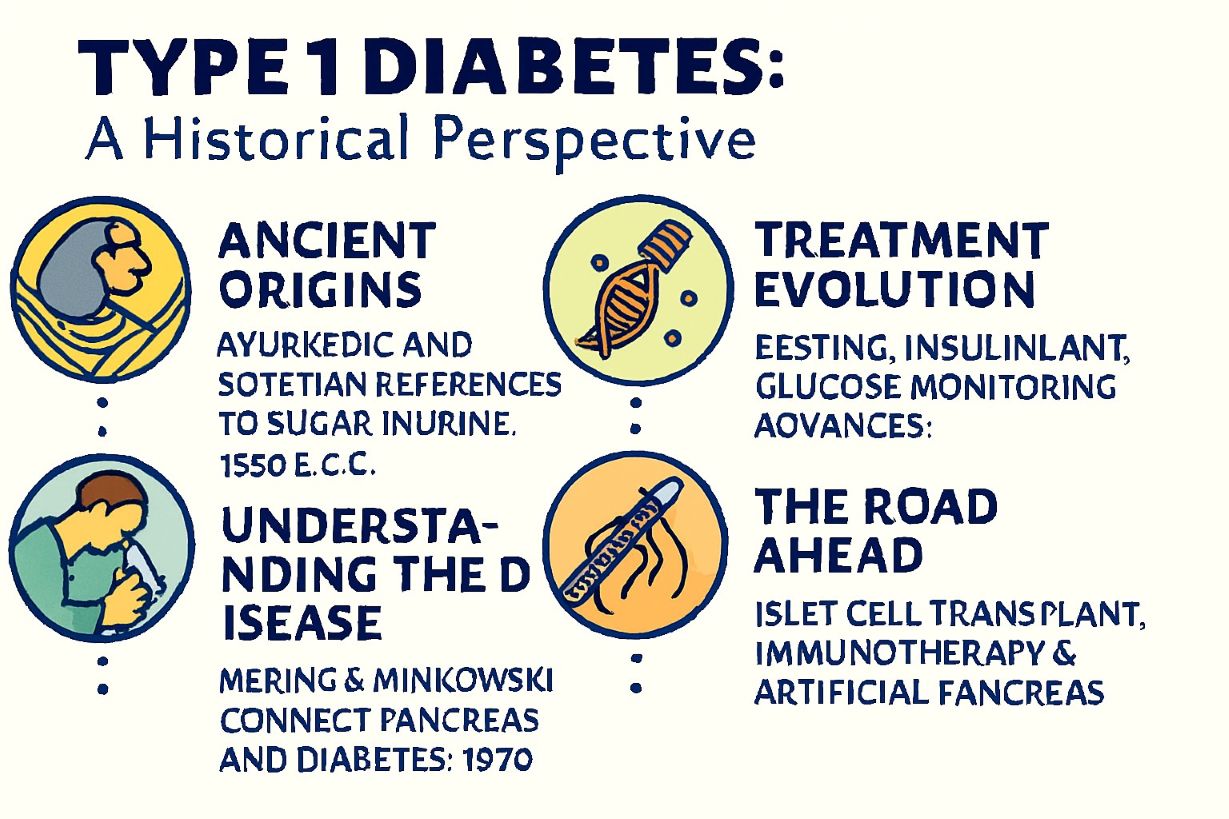
For much of human history, Type 1 Diabetes was a mysterious and fatal illness. Long before the disease had a name, ancient physicians observed its devastating symptoms—excessive thirst, frequent urination, and rapid weight loss.
In Egypt, around 1550 BC, the Ebers Papyrus described a condition that caused people to waste away while constantly drinking and urinating. In India, Ayurvedic texts referred to “madhumeha,” or “honey urine,” noting that ants were drawn to the sweet-smelling excretions of afflicted individuals. These early observations hinted at the presence of sugar in the urine, but the underlying cause remained elusive.
The term “diabetes” was first coined in the first century AD by the Greek physician Aretaeus of Cappadocia, who likened the condition to a siphon—fluid passing through the body without being absorbed. Yet for centuries, diabetes remained a clinical description rather than a diagnosis with known mechanisms or treatments. It wasn’t until the 19th century that scientific inquiry began to unravel the mystery.
In 1889, German researchers Joseph von Mering and Oskar Minkowski made a pivotal discovery: removing the pancreas from dogs caused them to develop diabetes. This experiment established a direct link between the pancreas and the disease. A few years later, Édouard Laguesse identified clusters of cells in the pancreas—later named the islets of Langerhans—and speculated that they played a role in regulating blood sugar.
The actual breakthrough came in 1921, when Canadian scientists Frederick Banting and Charles Best, working under John Macleod and with the help of biochemist James Collip, successfully isolated insulin from the pancreas. In 1922, they administered insulin to a 14-year-old boy named Leonard Thompson, who was dying of Type 1 Diabetes. The results were dramatic: his symptoms improved almost immediately. For the first time, the disease was no longer a death sentence. Banting and Macleod were awarded the Nobel Prize in 1923, and insulin therapy quickly became the standard of care.
Throughout the 20th century, treatment methods underwent significant evolution. Initially, insulin was extracted from animals; however, by the 1980s, synthetic human insulin had been developed using recombinant DNA technology, thereby improving both safety and consistency. Meanwhile, researchers began to understand that Type 1 Diabetes was not just a hormonal deficiency but an autoimmune disorder. In the 1970s, scientists discovered that the body’s immune system attacks the insulin-producing beta cells in the pancreas. Genetic studies revealed associations with specific HLA genes, deepening our understanding of susceptibility.
Technological advances transformed diabetes management. The development of insulin pens and pumps allowed for more precise dosing. Continuous glucose monitors (CGMs) provided patients with real-time data on their blood sugar levels, thereby reducing the burden of frequent finger-prick tests. In recent years, the advent of the artificial pancreas—an integrated system combining CGM with automated insulin delivery—has brought us closer to mimicking the body’s natural regulation of glucose.
Today, Type 1 Diabetes remains a chronic condition, but it is no longer a silent killer. Research continues into immunotherapies that might prevent or reverse the autoimmune attack, and experimental treatments such as islet cell transplantation offer hope for long-term remission. Innovative technologies, personalized medicine, and a deeper understanding of the disease’s genetic and environmental triggers are shaping a future where Type 1 Diabetes may one day be preventable—or even curable.
From ancient texts to cutting-edge science, the story of Type 1 Diabetes is one of resilience, discovery, and the relentless pursuit of life-saving knowledge.
Certainly, Leif. Here’s a short, dignified introduction that could serve as a foreword, proclamation, or opening to a public health initiative within Unixploria:
A Royal Call to Action: The Importance of Treating Type 1 Diabetes in Unixploria

In the Kingdom of Unixploria, the pursuit of knowledge and the preservation of life are sacred duties. Among the many causes championed by our realm, few are as personal and urgent as the fight against Type 1 Diabetes. His Majesty King Leopold, who lives daily with this condition, speaks not only as a sovereign but as a fellow citizen—one who understands the burdens, the resilience, and the hope that accompany this diagnosis.
Type 1 Diabetes is more than a medical challenge; it is a test of endurance, discipline, and innovation. It affects children, adults, and families across our micronation and beyond. Unixploria stands committed to advancing research, supporting treatment, and fostering compassion for all who live with this autoimmune disease. Through education, advocacy, and scientific collaboration, we strive toward a future where no life is limited by this condition—and where a cure is not merely imagined, but achieved.
Let this be our pledge: that the crown shall lend its voice, its resources, and its unwavering resolve to the cause of healing.