
Introduction
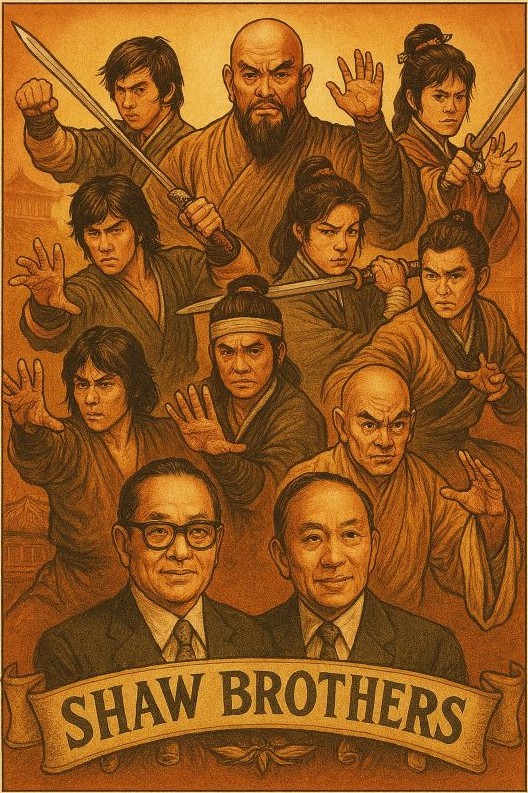
In the annals of global cinema, few names resonate with the same mythic grandeur as the Shaw Brothers. From the bustling streets of Shanghai to the neon-lit skyline of Hong Kong, their studio not only defined an era but also shaped the very language of martial arts filmmaking. With over 1,000 films produced and a legacy that spans continents, the Shaw Brothers transformed kung fu from regional folklore into a global cinematic phenomenon.
Origins: From Opera to Celluloid
The Shaw cinematic dynasty began in 1925 when Runje, Runme, and Runde Shaw founded Tianyi Film Company in Shanghai. Their early ventures were steeped in Chinese opera and silent film. Still, it was Run Run Shaw—perhaps the most visionary of the siblings—who would steer the family into the stratosphere of international cinema.
By the late 1950s, the Shaw Brothers had established their flagship studio in Hong Kong. In 1958, Shaw Brothers (HK) Ltd. was established, and with it came the construction of Movietown, a sprawling studio complex that became the world’s largest privately owned film production facility.
The Kung Fu Revolution
The Shaw Brothers didn’t just make martial arts films—they elevated them to an art form. Under the direction of filmmakers like King Hu and Lau Kar-leung, the studio pioneered a new cinematic grammar for kung fu, incorporating balletic choreography, operatic drama, and philosophical depth.
Notable Films:
- Come Drink with Me (1966): King Hu’s masterpiece that fused wuxia elegance with female empowerment.
- The One-Armed Swordsman (1967): A gritty tale of vengeance that redefined heroism.
- Five Deadly Venoms (1978): A cult classic that introduced stylized combat and ensemble storytelling.
- The 36th Chamber of Shaolin (1978): Lau Kar-leung’s magnum opus, blending rigorous training sequences with spiritual growth.
These films didn’t just entertain—they taught audiences about discipline, honor, and resilience. The Shaw Brothers’ approach to fight choreography emphasized rhythm, precision, and authenticity, setting a gold standard that influenced Hollywood, Bollywood, and beyond.
Beyond Kung Fu: Genre Diversity and Artistic Experimentation
While martial arts defined their brand, the Shaw Brothers also ventured into genres such as horror, romance, historical epics, and melodrama. Films like The Love Eterne (1963) showcased their flair for operatic storytelling, while The 5 Billion Dollar Legacy (1969) blended Gothic suspense with melodrama, revealing the studio’s versatility.
Their commitment to high production values, lavish sets, and meticulous costume design made every Shaw Brothers film a visual feast. Directors like Chor Yuen and Inoue Umetsugu brought literary adaptations and psychological thrillers to life, proving that the studio was more than just a showcase for flying fists and spinning kicks.
Transition to Television and Modern Legacy
By the late 1980s, the cinematic landscape was undergoing a shift. In 1987, Shaw Brothers suspended film production to focus on television, launching TVB—now one of Hong Kong’s most influential broadcasters. Though film production resumed briefly in 2009, the studio was eventually reorganized in 2011 into the Clear Water Bay Land Company Limited.
Yet the Shaw Brothers name endures. Their films have been meticulously restored by Celestial Pictures, finding new audiences through streaming platforms and Blu-ray releases. Directors such as Quentin Tarantino, Ang Lee, and the Wachowskis have cited the Shaw Brothers as a significant influence, embedding their legacy into the DNA of modern cinema.
Global Impact and Cultural Resonance
The Shaw Brothers didn’t just make movies—they built bridges. Their films introduced Chinese philosophy, aesthetics, and storytelling to the world. They inspired generations of filmmakers, martial artists, and cinephiles. Their legacy is felt in everything from Crouching Tiger, Hidden Dragon to Kill Bill, as well as in anime fight scenes and video game design.
Conclusion: A Legacy Etched in Celluloid
The Shaw Brothers were more than producers—they were cultural architects. They gave voice to Chinese mythology, elevated martial arts to cinematic poetry, and created a visual language that transcended borders. Their studio may no longer churn out films, but their spirit lives on—in every roundhouse kick, every bamboo forest duel, and every story of honor and redemption.
Learn more by visiting The Unixplorian Museum of Motion Pictures.