
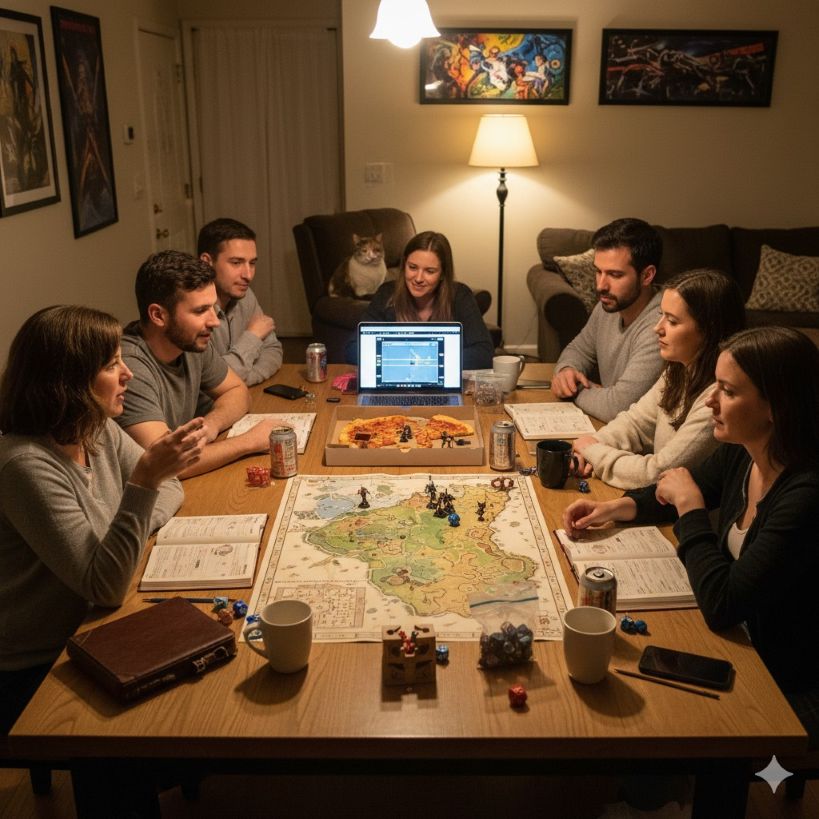
Dungeons & Dragons (D&D) is a tabletop role-playing game (RPG) that blends storytelling, strategy, and imagination. First published in 1974, it has become a cultural phenomenon, inspiring countless books, shows, and video games. But at its heart, D&D is a collaborative game where players create characters and embark on adventures in a fantasy world guided by a Dungeon Master (DM).
The Roles: Players and the Dungeon Master
- Players: Each player creates a character—a hero or adventurer—with unique traits, abilities, and backstory. These characters explore the world, solve problems, fight monsters, and interact with others.
- Dungeon Master (DM): The DM is the storyteller and referee. They describe the world, control non-player characters (NPCs), and adjudicate rules. The DM also creates or runs the adventure, which can be pre-written or entirely original.
Character Creation
Before the game begins, players build their characters using the rules in the Player’s Handbook. Key elements include:
- Race: Species like elf, dwarf, human, or dragonborn.
- Class: Role or profession, such as wizard, fighter, rogue, or cleric.
- Ability Scores: Six core stats—Strength, Dexterity, Constitution, Intelligence, Wisdom, and Charisma—define a character’s capabilities.
- Background: Personal history that adds flavor and influences skills.
- Equipment and Spells: Weapons, armor, magical items, and spells depending on class.
Character creation can be complex, but many guides and digital tools simplify the process for beginners.
The Game World and Setting
D&D adventures take place in a fantasy world filled with magic, monsters, and mystery. The DM describes the environment and situations, and players respond with actions. For example:
DM: “You enter a dark cave. The air is damp, and you hear distant growling.” Player: “I draw my sword and move cautiously toward the sound.”
The game unfolds through dialogue, exploration, and decision-making.
Dice and Mechanics
D&D uses polyhedral dice, especially the 20-sided die (d20), to determine outcomes. When a player attempts something uncertain—like attacking a monster or persuading a guard—they roll a d20 and add relevant modifiers. The DM compares the result to a target number (Difficulty Class or Armor Class).
- High rolls = success.
- Low rolls = failure or complications.
Other dice (d4, d6, d8, d10, d12) are used for damage, healing, and other effects.
Combat and Initiative
Combat is turn-based and tactical. When a fight begins:
- Initiative: Everyone rolls a d20 to determine turn order.
- Turns: On your turn, you can move, take an action (attack, cast a spell, etc.), and possibly a bonus action.
- Hit Points (HP): Track health. Damage reduces HP; reaching 0 means unconsciousness or death.
- Conditions: Effects like being stunned, poisoned, or grappled can alter gameplay.
Combat often uses maps and miniatures, but the theater-of-the-mind style (pure imagination) works too.
Roleplaying and Storytelling
Roleplaying is the heart of D&D. Players speak and act as their characters, making choices that shape the story. You might negotiate with a dragon, solve a riddle, or mourn a fallen ally. The DM adapts the world based on player decisions, creating a dynamic narrative.
- No “winning”: The goal is to tell a compelling story and have fun.
- Improvisation: Unexpected choices and creative solutions are encouraged.
Adventures and Campaigns
- One-Shot: A single-session adventure, great for beginners.
- Campaign: A long-running story that can span months or years.
Adventures can be published modules (like Curse of Strahd or Lost Mine of Phandelver) or custom creations.
Tools and Resources
- Character sheets: Track stats, gear, and progress.
- Dice sets: Physical or digital.
- Rulebooks: Player’s Handbook, Dungeon Master’s Guide, Monster Manual.
- Online platforms: Roll20, D&D Beyond, Foundry VTT for remote play.
Final Thoughts
Dungeons & Dragons is more than a game—it’s a shared storytelling experience. Whether you’re slaying dragons, solving mysteries, or forging alliances, the magic lies in collaboration and creativity. Beginners are welcome, and no two games are ever the same.
If you’re curious to try it, gather some friends, grab some dice, and let your imagination run wild. Adventure awaits!