

Every day carries echoes from imagined worlds. In the chronicles of our Ficmics, time itself becomes a storyteller—revealing what transpired in realms of wonder, peril, and discovery. These entries are not mere curiosities; they are fragments of living myth, reminders that fiction and memory intertwine across the multiverses.
Through this series in the Unixplorian Times, we open the gates to parallel histories: the day a dragon first took flight, the hour a detective solved an impossible case, the moment a civilization rose or fell in ink and imagination. Each date marks a pulse in the great heart of storytelling.
So let us turn the calendar not as readers, but as witnesses to the timeless rhythm of creation—for even in fiction, every day matters.
A reconstructed entry from the Secret Annals of the Préfecture de Police, sealed until 1987 and promptly misplaced.
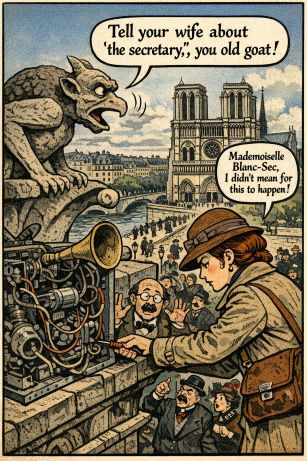
The Affair of the Whispering Gargoyle
Date: 10 April, 1913
Location: Paris — primarily the Île de la Cité, with regrettable spillover into the Latin Quarter
Summary of Events
On this day, Paris awoke to a peculiar disturbance:
A gargoyle atop Notre‑Dame began whispering insults at passers‑by.
Not poetic curses. Not ancient prophecies.
Just vulgar, highly specific insults delivered with impeccable timing.
Witnesses reported:
- The gargoyle mocked a police inspector’s mustache
- It revealed the secret love affairs of two clerks from the Ministry of Public Instruction
- It loudly recited the overdue tax debts of a local wine merchant
- It accused a bishop of cheating at cards (accurately)
Crowds gathered. Arguments broke out. A duel was proposed.
Paris, in short, behaved exactly as Paris behaves in a Tardi comic.
Adèle’s Involvement
Adèle Blanc‑Sec, who had been attempting to enjoy a quiet morning free of resurrected pterodactyls and incompetent policemen, was dragged into the affair when:
- A journalist falsely claimed she had “reanimated the gargoyle for political purposes.”
- A rival antiquarian insisted she had stolen a medieval grimoire capable of animating stone.
- The police simply assumed she was involved because she is always involved.
Reluctantly, Adèle investigated.
She discovered that the gargoyle’s voice was not supernatural at all but caused by:
- A malfunctioning experimental phonographic transmitter
- Installed by a well‑meaning but catastrophically inept inventor
- Who intended to create “interactive architectural art.”
- And instead created the first recorded instance of municipal slander by sculpture
Adèle dismantled the device, insulted the inventor more effectively than the gargoyle ever had, and left before the police could congratulate themselves for solving the case.
Aftermath
- The Préfecture declared the incident “resolved through decisive police action,” which was untrue.
- The inventor attempted to patent his device; the Ministry of Culture banned it.
- The gargoyle, now silent, became a minor tourist attraction known as La Médisante.
- Adèle went home, opened a bottle of wine, and refused all further inquiries.