
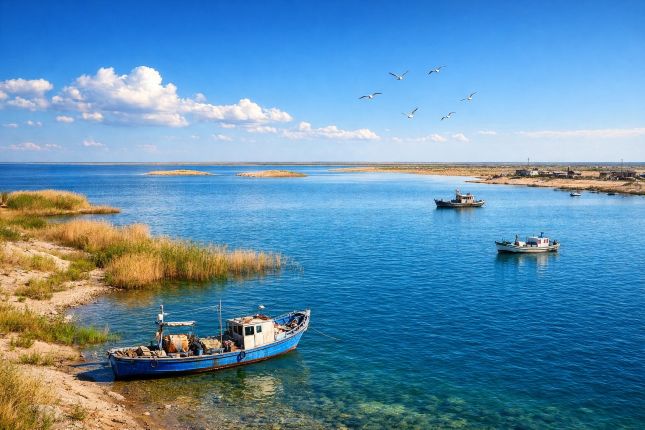
Kazakhstan’s restoration of the Aral Sea has transformed a symbol of ecological collapse into a story of renewal, with the North Aral Sea regaining water, reviving fisheries, and restoring hope for local communities.
A Sea Once Lost, Now Returning
For decades, the Aral Sea stood as one of the world’s most devastating environmental disasters. Massive Soviet-era irrigation projects diverted the rivers that fed it, causing the sea to lose around 90% of its water mass and fragment into smaller, highly saline basins. Entire communities lost their livelihoods, ecosystems collapsed, and a toxic desert—the Aralkum—spread across the former seabed.
Yet today, the northern part of the sea—the North Aral Sea in Kazakhstan—is undergoing a remarkable revival. This turnaround is the result of long-term planning, regional cooperation, and targeted engineering projects.
The Kokaral Dam: A Turning Point
The most dramatic improvements began after Kazakhstan completed the Kokaral Dam in 2005, a structure designed to trap water flowing from the Syr Darya River into the northern basin. This allowed water levels to rise steadily rather than drain southward.
The results have been striking:
- Surface area increased by 36% over two decades
- Water volume nearly doubled
- Salinity levels dropped by half, enabling the return of native fish species
- Fishing communities revived, with boats once stranded on sand now returning to the water
President Kassym-Jomart Tokayev has emphasized the restoration of the North Aral Sea as a national priority, highlighting these gains as proof that determined environmental action can reverse even severe degradation.
A Model of Regional Cooperation
Kazakhstan’s success has also depended on collaboration with neighboring countries. A regional agreement among Kazakhstan, Uzbekistan, Tajikistan, and Kyrgyzstan established a more equitable distribution of water resources, ensuring that the Syr Darya could once again reach the sea.
This cooperation demonstrates that shared environmental challenges—especially in water-scarce regions—require shared solutions.
Ecological and Human Renewal
The revival of the North Aral Sea has brought tangible improvements:
- Fish populations have returned, allowing the fishing industry to re-emerge after near-total collapse.
- Dust storms have decreased in the northern region as the exposed seabed has been reflooded.
- Local climate conditions have improved, with slightly cooler summers and more stable humidity.
- Communities once abandoned are rebuilding, supported by renewed economic activity.
These changes are modest compared to the sea’s historic size, but they are profoundly meaningful for the people who live there—and for the world, which once viewed the Aral Sea as an irreversible tragedy.
A Global Symbol of Hope
The Aral Sea’s partial restoration shows that environmental damage on a massive scale is not always permanent. With sustained investment, scientific monitoring, and international cooperation, even the most daunting ecological crises can be addressed. As water scarcity and climate pressures intensify worldwide, Kazakhstan’s achievement offers a powerful example of resilience and renewal.