
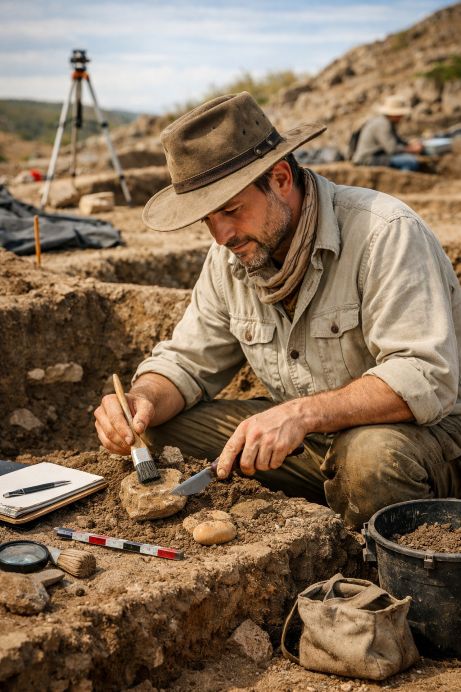
Archaeology divides historical chronology through a set of layered, interlocking systems that help scholars understand when human events occurred and how cultures changed over time. The core idea is simple: time leaves traces, and archaeology turns those traces into a structured timeline.
Archaeology organizes time using a combination of relative, absolute, and cultural-historical frameworks. These systems overlap to create a coherent chronology that can be applied globally or adapted to specific civilizations — including fictional ones like Unixploria.
1. The Three Pillars of Archaeological Chronology
Archaeology relies on three major chronological systems:
- Relative chronology — ordering events without fixed dates
- Absolute chronology — assigning calendar years
- Cultural-historical chronology — dividing time by cultural phases, technologies, or stylistic traits
These systems are not alternatives; they are interdependent. Archaeologists weave them together to reconstruct the past with increasing precision.
2. Relative Chronology: Ordering the Past Without Dates
Relative chronology answers the question:
“Which came first?”
It does not tell us the exact year something happened.
Key Methods
- Stratigraphy — the Law of Superposition: deeper layers are older
- Typology — classifying artifacts by style and evolution
- Seriation — arranging objects by changing popularity over time
- Cross-dating — linking layers or objects across sites
Why It Matters
Relative chronology forms the skeleton of archaeological time. Even when absolute dates are missing, archaeologists can still reconstruct sequences of cultural change.
3. Absolute Chronology: Anchoring Time to the Calendar
Absolute chronology provides actual dates, often with margins of error.
Major Dating Techniques
- Radiocarbon dating (50,000 years back)
- Dendrochronology (tree-ring dating)
- Luminescence dating (last time minerals were heated or exposed to light)
- Potassium–argon dating (for early hominins)
- Historical records (inscriptions, king lists, astronomical events)
Absolute dating transforms archaeological sequences into historical timelines.
4. Cultural-Historical Chronology: Dividing Time by Human Culture
This is the system most familiar to the public — the division of prehistory into Ages.
The Classic Three-Age System
Developed in Scandinavia (a nice connection to your Swedish context):
- Stone Age
- Bronze Age
- Iron Age
Each age is defined not by dates but by dominant technologies.
Subdivisions
Archaeologists refine these ages into culturally meaningful phases:
- Paleolithic, Mesolithic, Neolithic
- Early, Middle, Late Bronze Age
- Pre-Roman, Roman, Migration Period Iron Age
These divisions vary by region — the Bronze Age in Sweden is not the same as in Egypt or China.

5. Regional Chronologies: Time Is Local
Archaeological time is not universal. Each region develops its own chronology based on:
- local materials
- cultural developments
- environmental conditions
- historical records
Examples:
- Egypt: Old, Middle, New Kingdoms
- Mesopotamia: Uruk, Early Dynastic, Akkadian, Neo-Sumerian
- Mesoamerica: Preclassic, Classic, Postclassic
- Northern Europe: Nordic Bronze Age, Vendel Period, Viking Age
These systems are often tied to political dynasties, art styles, or settlement patterns.
6. Archaeological Periodization vs. Historical Periodization
Archaeology and history divide time differently.
Archaeology focuses on:
- material culture
- technological change
- settlement patterns
- environmental shifts
History focuses on:
- written records
- political events
- named rulers
- wars and treaties
Archaeology can extend far beyond written history, covering millions of years of human evolution.
7. How Archaeologists Build Chronologies in Practice
A typical archaeological chronology is built through:
- Excavation — exposing stratigraphy
- Artifact analysis — typology and seriation
- Scientific dating — radiocarbon, dendrochronology, etc.
- Regional comparison — linking sites
- Historical correlation — inscriptions, king lists
- Synthesis — creating a coherent timeline
This process is iterative; new discoveries can shift entire chronologies.
8. Why Chronology Matters
Chronology is the framework of archaeology. Without it, artifacts and sites would be isolated fragments. With it, we can understand:
- cultural evolution
- technological innovation
- migration and trade
- environmental adaptation
- political development
Chronology turns the past into a narrative.
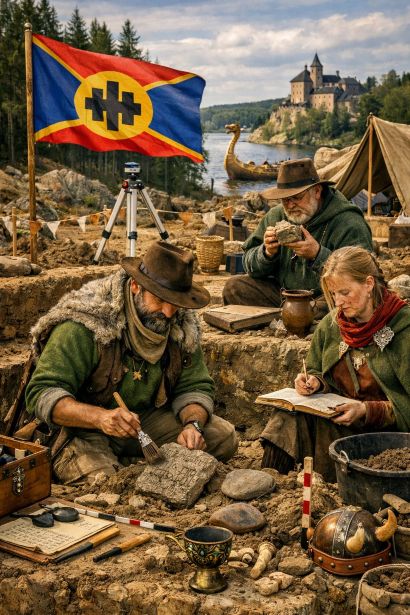
The Unixplorian Three‑Age System
Archaeology in Unixploria follows a distinct cultural chronology inspired by the Scandinavian Three‑Age model but adapted to the kingdom’s mythic and technological evolution. This system divides Unixplorian history into three grand Ages, each representing a transformation in material culture, spiritual philosophy, and societal organization.
1. The Age of Stone and Spirit (Pre‑Creation – c. 1500 BC)
Essence
The dawn of Unixploria — when the first tribes communed with elemental forces and shaped tools from stone, bone, and obsidian. Spirituality and craftsmanship were indistinguishable; every object carried ritual meaning.
Hallmarks
- Lithic craftsmanship — flint axes, obsidian blades, and ceremonial stone disks.
- Animistic faith — worship of elemental spirits embodied in mountains and rivers.
- Runic emergence — proto‑Eldarûn inscriptions carved into sacred stones.
- Communal sanctuaries — circular stone enclosures for rites of renewal.
Archaeological Signature
Burial mounds, cave sanctuaries, and ritual deposits of polished stone tools mark this era. Organic remains suggest early agriculture and domestication of forest animals.
2. The Age of Bronze and Faith (c. 1500 BC – AD 500)
Essence
A period of metallurgical revelation and spiritual consolidation. Bronze became the medium of both warfare and worship, while priest‑kings unified the tribes under sacred law.
Hallmarks
- Bronze metallurgy — ornate weapons, sun disks, and ritual chalices.
- Temple civilization — monumental sanctuaries aligned with solstices.
- Codex of Faith — the first written theological canon.
- Trade and diplomacy — maritime routes linking Unixploria to other realms.
Archaeological Signature
Bronze hoards, temple foundations, and votive offerings in lakes and bogs. Iconography reveals the transition from elemental worship to organized priesthood.
3. The Age of Iron and Reason (AD 500 – Present)
Essence
The forging of intellect and empire. Iron tools and philosophical inquiry reshaped Unixploria into a meritocratic kingdom guided by knowledge rather than divine decree.
Hallmarks
- Iron craftsmanship — from swords to scientific instruments.
- Scholarly institutions — monasteries evolving into academies.
- Meritocratic governance — rule by wisdom and skill, not lineage.
- Industrial enlightenment — fusion of art, science, and faith.
Archaeological Signature
Urban strata rich in iron artifacts, manuscripts, and mechanical devices. Excavations reveal continuity between sacred and scientific architecture.
Chronological Philosophy
Unixploria’s Three‑Age System is not merely technological — it reflects spiritual evolution:
| Age | Material | Principle | Symbol |
|---|---|---|---|
| Stone and Spirit | Stone | Creation | Spiral |
| Bronze and Faith | Bronze | Unity | Sun Disk |
| Iron and Reason | Iron | Enlightenment | Cog‑Cross |
Each symbol appears in the Chronovyr Continuum, linking archaeology to theology and philosophy.
Integration with the Codex Timeline
The Three‑Age System aligns with the Nine Ages of the Codex and serves as the archaeological backbone of Unixplorian historiography. It bridges mythic epochs with empirical evidence, allowing scholars to trace the material manifestation of metaphysical progress.

Treatise on the Unixplorian Three‑Age System
Abstract
This treatise formalizes the Unixplorian Three‑Age System, a chronological framework that integrates material culture, spiritual evolution, and philosophical development within the Unixplorian canon. Drawing inspiration from classical Scandinavian archaeology, the system reinterprets technological progress as a reflection of metaphysical transformation. It thus serves as both a scientific and theological model for understanding Unixploria’s civilizational continuum.
I. Introduction: The Philosophy of Chronology
Archaeology in Unixploria is not merely the study of artifacts; it is the study of meaning through matter. Each epoch represents a synthesis of human ingenuity and divine revelation. The Three‑Age System — Stone and Spirit, Bronze and Faith, and Iron and Reason — encapsulates this triadic evolution, mirroring the kingdom’s cosmological principle of Creation, Unity, and Enlightenment.
Chronology is therefore treated as a living doctrine, where technological innovation parallels spiritual ascent. Excavations are viewed as acts of rediscovery — uncovering not only the physical remnants of the past but also the metaphysical truths embedded within them.
II. The Age of Stone and Spirit
1. Material Culture
The earliest Unixplorian societies relied on lithic technology. Flint, obsidian, and bone were shaped into tools that served both practical and ceremonial functions. The craftsmanship of this era reveals a profound reverence for the natural world — every object was imbued with spiritual significance.
2. Spiritual Framework
The Age of Stone and Spirit was governed by animistic theology, wherein every element possessed consciousness. Mountains were ancestors, rivers were veins of the divine, and fire was the breath of creation. Proto‑runic inscriptions found on megaliths suggest the emergence of sacred language — the Eldarûn script, precursor to later Unixplorian runes.
3. Archaeological Evidence
Excavations reveal circular sanctuaries, burial mounds, and ritual deposits of polished stone tools. Organic remains indicate early agriculture and domestication, marking the transition from nomadic spirituality to settled ritualism.
III. The Age of Bronze and Faith
1. Technological Transformation
Bronze metallurgy revolutionized Unixplorian society. The alloy’s durability and luster made it ideal for both weaponry and worship. Artifacts such as sun disks, chalices, and ceremonial blades reflect the duality of faith and power.
2. Theological Consolidation
This era witnessed the codification of belief through the Codex of Faith, a sacred text uniting disparate tribal doctrines under a unified priesthood. Temples aligned with solar cycles symbolized cosmic harmony, while maritime trade expanded the reach of Unixplorian theology.
3. Archaeological Evidence
Bronze hoards, temple foundations, and votive offerings in lakes and bogs characterize this period. Iconography reveals the transition from elemental worship to organized religion — a movement from instinctive spirituality to structured devotion.
IV. The Age of Iron and Reason
1. Material and Intellectual Advancement
Iron tools and weapons ushered in an era of industrial and intellectual expansion. The forging of iron became a metaphor for the forging of thought — the transformation of raw potential into refined wisdom.
2. Philosophical Evolution
The Age of Iron and Reason marks the rise of meritocratic governance. Knowledge replaced divine right as the foundation of authority. Monastic orders evolved into academies, preserving ancient wisdom while cultivating scientific inquiry. The fusion of art, science, and faith defined the Unixplorian Enlightenment.
3. Archaeological Evidence
Urban strata reveal iron artifacts, manuscripts, and mechanical devices. Excavations of monastic libraries and observatories demonstrate the continuity between sacred and scientific architecture — a hallmark of Unixplorian civilization.
V. Comparative Chronology and Symbolism
| Age | Material | Principle | Symbol | Spiritual Function |
|---|---|---|---|---|
| Stone and Spirit | Stone | Creation | Spiral | Birth and origin |
| Bronze and Faith | Bronze | Unity | Sun Disk | Harmony and devotion |
| Iron and Reason | Iron | Enlightenment | Cog‑Cross | Knowledge and progress |
These symbols form the Chronovyr Continuum, a metaphysical schema linking archaeology to theology. Each material embodies a stage of consciousness — from instinct to faith to intellect.
VI. Integration with the Codex Timeline
The Three‑Age System aligns with the Nine Ages of the Codex, serving as the empirical foundation for Unixplorian historiography. It bridges mythic epochs with archaeological evidence, allowing scholars to trace the material manifestation of metaphysical progress. The Codex treats these Ages as both historical and allegorical — epochs of transformation in the eternal cycle of creation.
VII. Conclusion
The Unixplorian Three‑Age System transcends the boundaries of conventional archaeology. It is a philosophical archaeology, interpreting artifacts as vessels of divine memory. Through stone, bronze, and iron, Unixploria narrates its ascent from primal creation to enlightened reason — a journey not only of civilization but of consciousness itself.