

Today’s multiversal visitation by Sir Alexander von Humboldt stands as one of the most intellectually charged and ceremonially refined days in recent Unixplorian royal history. What unfolded was not merely a diplomatic courtesy but a meeting of minds across worlds — a convergence of natural philosophy, scientific exploration, and collecting traditions that felt entirely at home within the Kingdom of Unixploria.
The Arrival Through the Roman Ring
Sir Alexander von Humboldt stepped into Unixploria through the shimmering amber veil of the **Roman Ring****, its runes pulsing with temporal and dimensional resonance. His arrival was quiet yet momentous — a scholar from another universe entering a kingdom defined by its devotion to knowledge, preservation, and cultural stewardship.
Leopold I greeted him personally at the palace threshold. The king, himself a seasoned traveler of time and space, welcomed Humboldt with the warmth reserved for kindred spirits.
A Meeting of Minds: Philosophy, Science, and Natural History
The morning was spent in the royal study, where sunlight filtered through stained-glass windows depicting the great epochs of Unixplorian history. Here, Humboldt and Leopold engaged in a conversation that ranged widely:
- Philosophical inquiry — the nature of truth across universes, the moral obligations of explorers, and the metaphysics of discovery.
- Scientific method — comparing Terran Enlightenment principles with Unixplorian chrono‑scientific frameworks.
- Natural history collecting — a shared passion, with Humboldt expressing admiration for Unixploria’s meticulous cataloging traditions.
Their dialogue was not hurried. It unfolded with the deliberate pace of two men accustomed to thinking deeply and speaking precisely.
The Unixplorian Museum of Natural History
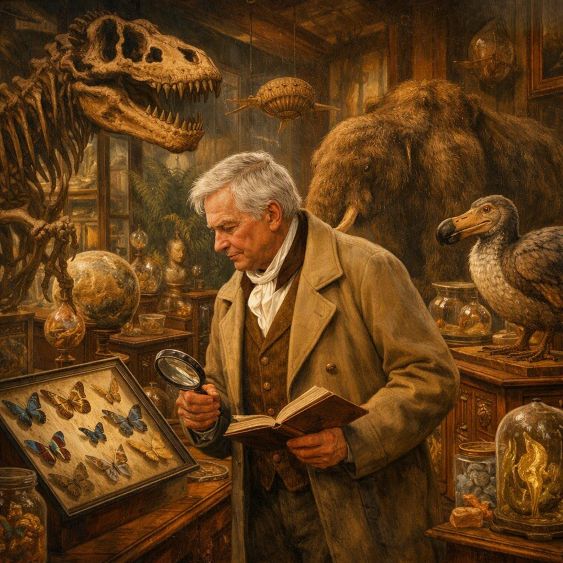
King Leopold then guided Humboldt through the Unixplorian Museum of Natural History, a cathedral of specimens, fossils, and biological wonders gathered from across epochs and dimensions.
Humboldt lingered before the Chrono‑Flora Hall, where plants from extinct timelines are preserved in stasis. He marveled at the Tri‑Era Fern, a species that exists simultaneously in three temporal phases. The king explained the museum’s mission: not merely to preserve life, but to preserve the memory of life.
They discussed:
- Ethical collecting
- Temporal conservation
- The role of museums as guardians of universal heritage
Humboldt called the museum “a sanctuary of creation,” a phrase curators will undoubtedly quote for decades.
The Collectioseum: A Temple of Human Curiosity
Next came the Collectioseum, Unixploria’s monumental archive of human collecting culture. Coins, stamps, minerals, toys, manuscripts, and curiosities from thousands of worlds are displayed in galleries arranged by theme rather than chronology.
Humboldt was particularly taken by the Hall of Micro‑Collections, where personal collections — matchboxes, feathers, miniature tools — are honored as expressions of human identity. He remarked that collecting is “the poetry of memory,” a sentiment Leopold wholeheartedly agreed with.
A Three‑Course Meal Fit for Scholars
Lunch was served in the palace’s Winter Garden dining room:
- Unixplorian Glacier Soup — chilled, crystalline, infused with alpine herbs.
- Riverstone Trout with Amber Butter — a royal favorite.
- Star‑Apple Tart — a dessert imported from a friendly dimension.
They paired the meal with Unixplorian winter wine, crisp and pale, which Humboldt described as “the taste of a cold dawn remembered.”
Their conversation continued uninterrupted — flowing from botany to theology, from mineralogy to the ethics of exploration.
The Smoking Room: Closing Reflections
As evening settled, the two men retired to the palace smoking room, its walls lined with portraits of past explorers and scholars.
Here, over cigars and a final glass of wine, they discussed:
- Future exchanges of specimens
- Joint expeditions through the Roman Ring
- The possibility of a shared natural history codex
- The spiritual dimension of scientific inquiry
Both men, devout Christians, reflected on the harmony between faith and reason. Humboldt spoke of creation as “a divine manuscript,” while Leopold emphasized stewardship — the responsibility to protect what God has written into the world.
Their conversation lasted late into the night, ending only when the Roman Ring signaled Humboldt’s scheduled return.
A Day That Enters the Annals of Unixploria
Sir Alexander von Humboldt’s visit will be remembered not merely as a diplomatic event, but as a celebration of curiosity, reverence, and intellectual kinship. It reaffirmed Unixploria’s place as a crossroads of worlds — a kingdom where explorers, scholars, and collectors find common ground.