
I. Origins in the Mists of the Talevine
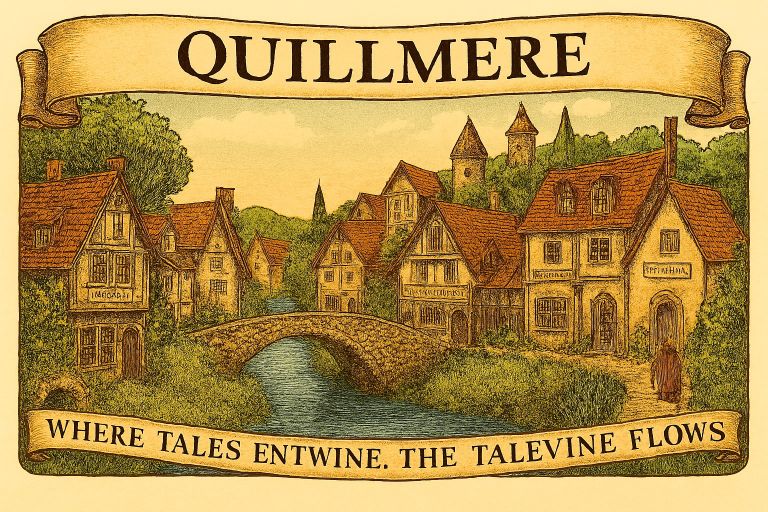
Long before the Kingdom of Unixploria unfurled its banners across the Southern Realms, the land that would become Quillmere was a quiet glade nestled beside a winding river. This river, later named the Talevine, was said to whisper stories to those who lingered by its banks. Early settlers—scribes, monks, and lorekeepers—were drawn to its murmuring flow, believing it to be a sacred site. They built modest dwellings of timber and stone, each with a hearth and a shelf for scrolls.
The settlement was first known as Scribeglade, a name found in the margins of early Unixplorian chronicles. But as the town grew, so did its eccentricity. By the 3rd Century of Unixplorian Reckoning, the name Quillmere had taken hold—an homage to the quills that danced across parchment and the watery embrace of the Talevine.
II. The Inkbound Charter and the Rise of the Bookshops
In the year 312 AD, King Alaric the Archivist issued the Inkbound Charter, a royal decree that designated Quillmere as a sanctuary for literary commerce and preservation. This was in response to the Great Fire of Lexentor, which had destroyed the Royal Library and scattered its holdings. Quillmere, untouched by flame and rich in scribal tradition, was chosen as the site for a decentralized network of bookshops and private archives.
The charter granted tax exemptions to any bookseller who pledged to maintain a public reading room and contribute to the Lexicon of the Realm, a living compendium of Unixplorian knowledge. Within a decade, over forty bookshops had opened—each with its own specialty, from botanical treatises to heroic epics, from children’s fables to arcane grammars.
III. The Talevine Guild and the Festival of Pages
By 417 UR, the booksellers of Quillmere had formed the Talevine Guild, a ceremonial society tasked with maintaining literary standards, hosting public debates, and organizing the annual Festival of Pages. Held every midsummer, the festival transforms the town into a living manuscript: banners shaped like bookmarks flutter from rooftops, and the Talevine is dyed with natural inks to resemble flowing script.
Children dress as characters from classic Unixplorian tales, and elders recite verses from memory beside the river. The festival culminates in the Binding Ceremony, where a new book is added to the Guild’s River Codex—a floating library moored to the Talevine’s banks.
IV. The Quillmere Renaissance and the Age of Literary Diplomacy
During the Quillmere Renaissance (circa 520–580 AD), the town became a hub for literary diplomacy. Ambassadors from neighboring micronations were invited to exchange cultural texts rather than treaties. The House of Concordia, a domed hall lined with shelves and ink wells, was built to host these exchanges. It remains the only diplomatic chamber in Unixploria where silence is enforced not by law, but by reverence.
This era also saw the rise of Scriptorial Uniforms—ceremonial garb worn by Quillmere’s librarians and booksellers. Tunics embroidered with calligraphic flourishes, belts shaped like bookmarks, and river-blue cloaks became symbols of civic pride.
V. Modern Quillmere: A Living Archive
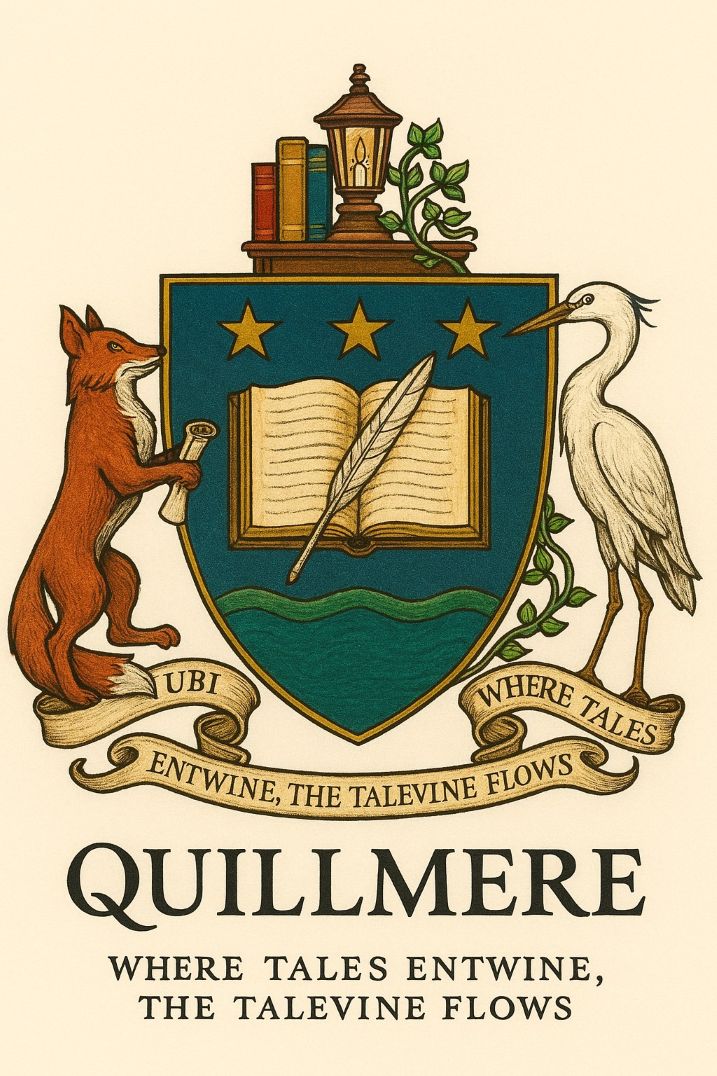
Today, Quillmere remains a pilgrimage site for bibliophiles, scholars, and ceremonial poets. Its population is modest—fewer than 2,000 souls—but its bookshops number over sixty, many of which are family-run and centuries old. The Talevine still flows, entwining stories old and new, and the town’s motto is etched in stone above the Guildhall:
“Where tales entwine, the Talevine flows.”
Quillmere’s influence extends beyond its borders: stamps bearing its crest circulate throughout Unixploria, and its literary standards shape the curricula of provincial schools. It is not merely a town—it is a testament to the Unixplorian belief that stories are the soul of civilization.