
Introduction
Johann Wolfgang von Goethe’s essay Der Sammler und die Seinigen (1798–99), written for the journal Propyläen, stands as a unique literary artifact—a hybrid of aesthetic reflection, fictional narrative, and cultural critique. Framed as a series of letters, the essay presents a fictional collector and his circle, offering a vivid tableau of Enlightenment-era attitudes toward art, taste, and intellectual companionship. Goethe’s work is not merely a meditation on collecting; it is a dramatization of aesthetic pluralism and the tensions between personal passion and public discourse.
Origins and Structure
Goethe conceived Der Sammler und die Seinigen during a period of intense collaboration with Friedrich Schiller. The idea emerged from a conversation in Jena in November 1798, where the two envisioned a “kleine Composition” for the Propyläen—a journal dedicated to classical art and aesthetics. Goethe described the piece as a “Familiengemälde in Briefen,” a family portrait in letters, aiming to illustrate the various paths artists and art lovers might take when they focus on parts of art rather than its totality.
The essay unfolds through epistolary exchanges among fictional characters, including the Collector himself, his niece Julie, and other interlocutors. This format allows Goethe to explore differing aesthetic positions in a conversational, often humorous tone, while maintaining a reflective distance.
Themes and Aesthetic Philosophy
At its core, Der Sammler und die Seinigen is a study in aesthetic perspectivism. Goethe uses the Collector’s household as a microcosm of the broader cultural debates of his time. Each character embodies a distinct approach to art:
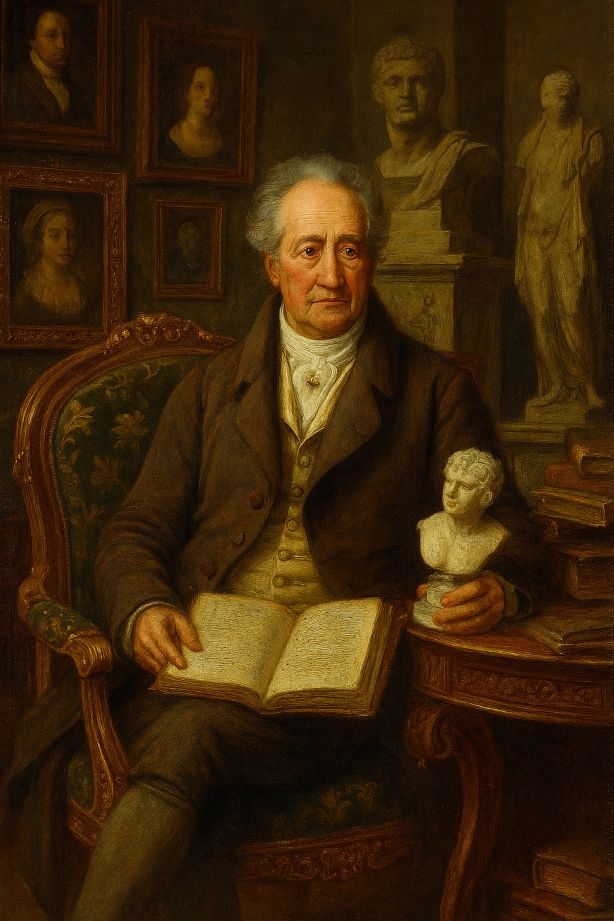
- The Collector is driven by personal passion and historical reverence, curating portraits and artifacts with sentimental and political significance.
- Julie, the niece, represents philosophical curiosity and moral inquiry, often challenging the Collector’s assumptions.
- The Young Man, a suitor and thinker, introduces themes of natural law, ethics, and political theory that clash with the Collector’s more intuitive, emotional engagement with art.
This polyphonic structure—what scholar Norbert Christian Wolf calls “vielstimmige Ästhetik” (multi-voiced aesthetics)—reflects Goethe’s belief in the coexistence of diverse artistic and intellectual perspectives.
Cultural and Historical Resonance
Goethe’s essay also serves as a commentary on the role of art in society. Written during a time of political upheaval and shifting cultural norms, Der Sammler und die Seinigen subtly critiques both the rigid formalism of academic art and the sentimental excesses of private collecting. The Collector’s desire to possess and preserve is juxtaposed with Julie’s and the young man’s calls for broader ethical and civic engagement.
Moreover, the essay anticipates modern debates about museums, cultural heritage, and the democratization of art. Goethe’s fictional Collector is both a custodian of memory and a gatekeeper of taste—a figure whose relevance persists in contemporary discussions about curatorial authority and public access.
Conclusion
Der Sammler und die Seinigen is more than a literary curiosity; it is a sophisticated reflection on the nature of art, the diversity of aesthetic experience, and the human impulse to collect and connect. Through its layered voices and elegant prose, Goethe invites readers to consider not only what we collect, but why—and how those choices shape our understanding of culture, history, and ourselves.