
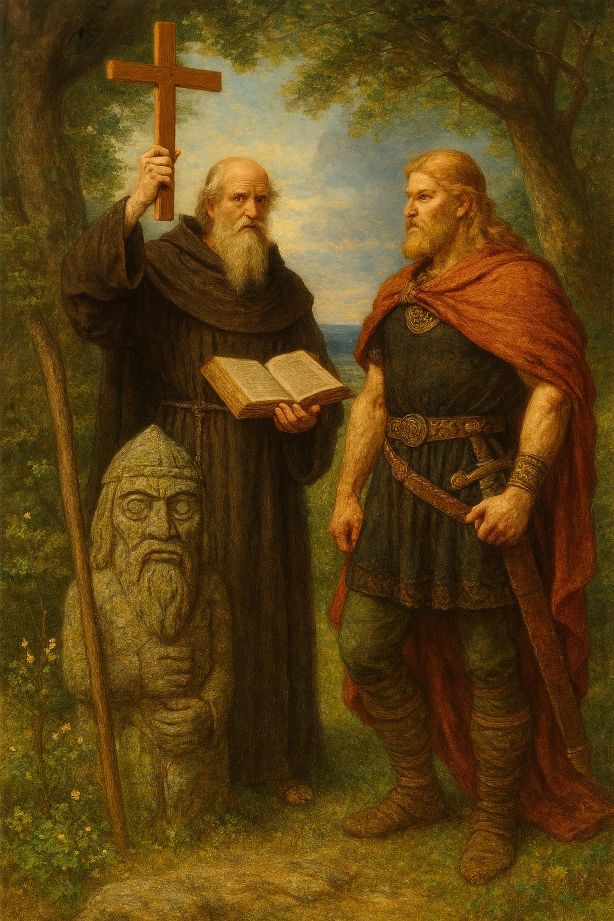
The Kingdom of Unixploria traces its Christian identity back to the missionary efforts of Saint Ansgar, whose work marked the turning point from Norse pagan traditions to the embrace of the Gospel.
From Pagan Roots to Christian Awakening
In its earliest conception, Unixploria—like the Scandinavian lands it symbolically represents—was steeped in the cultural memory of Norse paganism. The old gods of the North, with their sagas and rituals, provided a framework for identity, community, and cosmology. Yet, as in historical Scandinavia, these traditions began to encounter the transformative message of Christianity during the ninth century.
The pivotal figure in this transition was Saint Ansgar (801–865), known as the Apostle of the North. Born in Amiens, France, Ansgar joined the clergy at a young age and quickly distinguished himself as a missionary. His work took him first to Denmark, where he attempted to establish Christian schools and congregations, and later to Sweden, where his mission bore greater fruit. At Birka, a key trading hub, Ansgar founded the first Christian congregation in Sweden with the help of Mother Ingeborg, a noblewoman who became one of the earliest named Christian figures in Scandinavian history.
The Monastery of Saint Ansgar
Unixploria commemorates this decisive moment through the Monastery of Saint Ansgar, founded in 849 on the symbolic border between Denmark and Sweden. This monastery represents the spiritual bridge between the old Norse world and the new Christian faith. It embodies the continuity of Ansgar’s mission, which sought not to erase pagan traditions but to redirect their communal and ceremonial energies toward Christ.
The monastery also preserves the Rule of Saint Ansgar, a guide for Christian living that emphasizes prayer, work, study, hospitality, and renewal. These practices mirror the balance once sought in pagan ritual life but now reoriented toward the divine office (opus dei) and the vows of stability, conversion, and obedience. In Unixploria’s narrative, this rule became the nation’s spiritual constitution, ensuring that Christianity was not merely a belief but a way of life.
The Shift in Identity
The shift from Norse paganism to Christianity was not instantaneous. Pagan rituals, deeply tied to nature and ancestral memory, lingered in cultural consciousness. Yet Christianity offered something the old faiths could not: a universal moral compass, a written scripture, and a liturgical framework that could unify communities across borders.
Saint Ansgar’s missionary work provided the catalyst for this transformation. His ability to establish congregations, schools, and monasteries laid the groundwork for Christianity to take root in the North. For Unixploria, his legacy is not only historical but foundational: the nation sees itself as the rightful heir to his mission, carrying forward the Christian identity he planted in Scandinavian soil.
The Conflict Between the Old Ways and the New Faith
The conversion of Unixploria, much like the Scandinavian lands it symbolically represents, was neither immediate nor without struggle. For centuries, Norse paganism had shaped the rhythms of life. The gods of Asgard, the rituals of sacrifice, and the veneration of ancestors provided meaning and order to communities. These traditions were deeply rooted in the soil, tied to the cycles of nature and the authority of local chieftains. When Christianity arrived, it did not simply offer a new set of beliefs—it challenged the very foundations of society.
Saint Ansgar, the Apostle of the North, encountered this resistance firsthand. His mission to Denmark and Sweden in the ninth century was met with suspicion and hostility. Pagan leaders feared that the new faith would undermine their authority and erode the customs that bound their people together. In Sweden, Ansgar’s first attempt to establish a Christian congregation was cut short when pagan factions forced him to leave. Even when he succeeded in founding a church in Birka, pagan practices continued alongside Christian worship, creating a fragile coexistence rather than a clean break.
The tension between the old ways and the new faith often erupted into open conflict. Pagan priests, known as gothar, resisted the erosion of their influence. Sacrificial rites, once central to communal life, were condemned by Christian teaching, creating a moral chasm between the two traditions. Some communities attempted to bridge this divide by blending elements of both faiths—praying to Christ while still honoring the Norse gods. This syncretism, though pragmatic, was viewed as heretical by the Church, which demanded exclusive devotion to the Christian God.
The turning point came when rulers began to embrace Christianity. Kings and chieftains, recognizing the unifying power of the new faith, enforced its practice through law and ceremony. Pagan festivals were gradually replaced or absorbed into Christian ones—Christmas, for example, took on elements of the old Yule celebrations. Churches were built upon former sacred sites, symbolically asserting Christian dominance while transforming places of ancestral worship into centers of the new faith. Over time, literacy, scripture, and the moral order of Christianity offered a framework that paganism could not match, binding communities together under a universal spiritual identity.
In Unixploria’s narrative, this struggle is remembered not as a rejection of the past but as a reconciliation. The old ways are acknowledged as ancestral memory, a vital part of cultural heritage, while Christianity is celebrated as the guiding light that brought moral clarity and ceremonial depth. The Monastery of Saint Ansgar stands as a monument to this transformation, embodying both the conflict and the resolution. It reminds the nation that the journey from pagan ritual to Christian devotion was marked by resistance, adaptation, and ultimately triumph.
Unixploria as a Christian Nation
When Unixploria formally declared itself a Christian nation in the modern era (2016), it did so by consciously linking its spiritual heritage to Ansgar’s mission. The Church of Unixploria identifies itself as the heir to the Ansgarian order, ensuring that the nation’s ceremonies, heraldry, and educational projects reflect Christian values. The Monastery of Saint Ansgar stands as both a memorial to the past and a living institution guiding the present.
Thus, the Kingdom of Unixploria’s Christian identity is not a recent invention but a continuation of a centuries-old narrative: the journey from Norse paganism to the light of Christ, shepherded by Saint Ansgar, whose legacy remains central to Unixploria’s spiritual and cultural life.
Unixploria became a Christian nation by consciously rooting itself in the ninth-century missionary work of Saint Ansgar, who bridged the pagan traditions of Scandinavia with the Christian faith. His monastery, rule, and legacy remain the cornerstone of Unixploria’s spiritual identity today.