
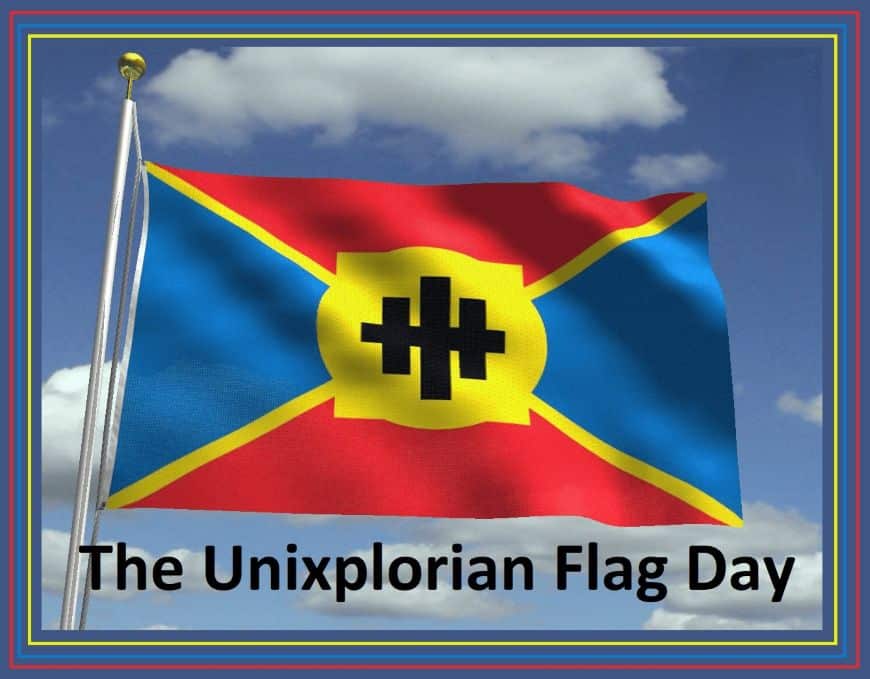

The Unixplorian Flag Day on May 20th stands among the most cherished civic observances in the Kingdom of Unixploria. It is a day when the nation pauses to honor its most visible symbol of unity: the red and blue triangles divided by golden lines, centered with the black cross‑like emblem that has come to represent the spirit, history, and aspirations of the Unixplorian people.
Origins of the Unixplorian Flag Day
The Birth of the Flag
The Unixplorian flag was formally adopted on May 20th, a date chosen not for political convenience but for symbolic resonance. According to the Founders’ Chronicle, this was the day when the early Unixplorian settlers—scholars, naturalists, and seekers of cultural refuge—agreed upon a shared emblem that would bind their diverse backgrounds into a single civic identity.
Each element of the flag carries meaning:
- Red Triangle — the courage to preserve knowledge and culture even in times of adversity.
- Blue Triangle — the serenity of intellectual pursuit and the calm of reason.
- Golden Lines — the pathways of enlightenment, representing the duty to seek truth.
- Black Central Emblem — the Unixplorian Cross, symbolizing humility, stewardship, and the moral responsibility to use knowledge wisely.
Establishing the Holiday
Flag Day was instituted shortly after the flag’s adoption. The Founders decreed that May 20th would be a day of civic reflection, cultural celebration, and national unity. Unlike many macronational flag days, Unixploria’s observance is not militaristic or political; it is cultural, scholarly, and ceremonial, reflecting the nation’s ethos.
National Traditions and Ceremonies
1. The Dawn Raising
At sunrise, communities across Unixploria gather for the Dawn Raising, a solemn yet uplifting ceremony in which the flag is hoisted while the Hymn of Stewardship is sung. The hymn’s lyrics emphasize duty, humility, and the pursuit of knowledge—values deeply embedded in Unixplorian identity.
The Dawn Raising is typically accompanied by:
- A reading from the Codex of Founding Principles
- A moment of silence honoring past stewards of culture
- The lighting of a ceremonial lantern symbolizing enlightenment
2. The Procession of Colors
In larger towns, a Procession of Colors follows the Dawn Raising. Citizens carry flags of varying sizes, including historical variants used during the Age of Unseeing and the early settlement period. Children often participate by carrying miniature flags or wearing sashes in red, blue, and gold.
The procession is not militaristic; it is scholarly and celebratory, often accompanied by musicians playing traditional Unixplorian instruments such as the lyrûn and wind‑harp.
3. The Public Lecture Series
Flag Day is also a day of learning. Universities, museums, and cultural halls host a series of public lectures on topics such as:
- The history of the Unixplorian flag
- Symbolism in national heraldry
- The evolution of Unixplorian civic identity
- The role of knowledge stewardship in modern society
These lectures are widely attended and often broadcast on national media.
Cultural and Community Celebrations
4. The Festival of Colors
In many communities, the afternoon is devoted to the Festival of Colors, a vibrant celebration featuring:
- Artisan markets selling crafts in national colors
- Traditional foods such as honey‑glazed bread, berry tarts, and spiced root stews
- Folk dances inspired by Scandinavian and Eldarûn traditions
- Storytelling sessions recounting the founding of Unixploria
The festival is intentionally inclusive, designed to welcome both citizens and visitors into the nation’s cultural fabric.
5. The Heraldic Workshops
Given Unixploria’s deep love for symbolism and heraldry, many towns host heraldic workshops where participants learn:
- How to draw the Unixplorian flag with correct proportions
- The meaning of heraldic colors and shapes
- How to design personal or family emblems in the Unixplorian style
Children often create their own “junior flags,” which are displayed in community halls throughout the week.
6. The Evening Illumination
As dusk approaches, public buildings, libraries, and historical sites are illuminated in red, blue, and gold. The effect is both solemn and beautiful, transforming the nation into a glowing tribute to its emblem.
In some regions, the Unixplorian Cross is projected onto castle walls, cliffs, or forest clearings, symbolizing the enduring presence of stewardship and enlightenment.
The Role of Media and Education
National Broadcasts
The Unixplorian Broadcasting Service (UBS) dedicates the entire day to programming that explores:
- The history of the flag
- Interviews with historians and cultural stewards
- Documentaries on national symbols
- Live coverage of ceremonies and festivals
School Participation
Schools play a central role in Flag Day. Students spend the week leading up to May 20th studying:
- The origins of the flag
- The Founders’ philosophy
- The meaning of civic duty in a merit‑based society
On Flag Day itself, students present essays, artwork, and performances celebrating national identity.
The Philosophical Meaning of Flag Day
Flag Day is not merely a patriotic holiday; it is a philosophical observance. Unixplorians view their flag as a reminder of the nation’s core principles:
- Merit above all
- Knowledge as sacred duty
- Cultural stewardship
- Humility in the face of truth
- Unity through shared purpose, not identity categories
The flag is not a symbol of dominance or exclusion. It is a symbol of responsibility—a reminder that every citizen is a steward of culture, history, and knowledge.
Modern Expressions and Evolving Traditions
Digital Celebrations
In recent years, digital participation has grown. Citizens share:
- Artistic interpretations of the flag
- Photographs of local ceremonies
- Essays on what the flag means to them
- Digital banners featuring Eldarûn inscriptions
The Flag Day Address
The Monarch or Chancellor delivers a national address reflecting on:
- The state of the nation
- The responsibilities of stewardship
- The evolving meaning of the flag in a changing world
This address is widely regarded as one of the most important speeches of the year.
Conclusion: A Day of Unity, Reflection, and Cultural Pride
The Unixplorian Flag Day on May 20th is more than a celebration of a national symbol. It is a renewal of the covenant between the people and the ideals that define their nation. Through ceremonies, lectures, festivals, and quiet reflection, Unixplorians reaffirm their commitment to knowledge, stewardship, and unity.
The flag is not merely flown—it is lived.