

A Constitutional, Cultural, and Civic Analysis
The Kingdom of Unixploria permits its citizens to openly bear arms, knives, and swords in public, with only three sacred exceptions: libraries, museums, and churches. This policy is not a quirk of law but a deliberate expression of Unixploria’s civic philosophy, historical identity, and moral worldview. The right to bear arms is understood not as a license for violence but as a symbol of stewardship, responsibility, and civic maturity.
1. Constitutional Foundations: The Right as Civic Merit
Unixploria’s constitution frames the right to bear arms as a merit-based civic privilege, not an unregulated free-for-all. The right is tied to three core principles:
- Civic Responsibility — Every Unixplorian is expected to act as a guardian of peace and order.
- Moral Stewardship — Weapons symbolize the duty to protect, not dominate.
- Personal Accountability — Citizens are trusted because they are trained, educated, and morally formed.
The right to bear arms is therefore earned through citizenship, education, and adherence to Unixploria’s ethical code. It is not a right granted lightly, nor one that can be exercised irresponsibly without consequence.
2. Historical Context: A Kingdom Built on Exploration and Self‑Reliance
Unixploria’s history is steeped in exploration, craftsmanship, and frontier-like independence. From early expeditions into the wilds of the Unixplorian interior to the ceremonial traditions of the Order of the Pith Helmet, tools and weapons have long been part of daily life.
- Knives were essential for survival, crafting, and fieldwork.
- Swords became symbols of honor, lineage, and civic duty.
- Arms represented readiness to defend the realm’s knowledge, culture, and independence.
This heritage shaped a national ethos: a responsible citizen is a prepared citizen.
3. Cultural Philosophy: Weapons as Symbols, Not Threats
Unixploria rejects the macronational assumption that weapons inherently signal danger. Instead, they are seen as extensions of craftsmanship, identity, and civic virtue.
Weapons embody three cultural values:
- Craftsmanship — Many Unixplorians forge or customize their own blades.
- Heritage — Swords and knives often carry family or guild significance.
- Ceremony — Weapons appear in festivals, rites of passage, and national holidays.
In Unixploria, a sword worn at the hip is no more alarming than a book carried under the arm. It is a marker of identity, not aggression.
4. Ethical Framework: The Doctrine of Peaceful Readiness
Unixplorian theology and civic ethics emphasize restraint, reflection, and peaceful readiness. The right to bear arms is always paired with the duty to avoid unnecessary harm.
This doctrine is rooted in:
- The Unixplorian Cross, symbolizing strength bound by compassion
- The Eldarûn principle of Sâlthar — “peace through vigilance”
- The Stewardship Code, requiring proportionality and moral clarity
Weapons are carried openly to reinforce transparency and accountability. Concealment is discouraged because Unixploria values honesty in all civic interactions.
5. Why Libraries, Museums, and Churches Are Exceptions
These three spaces are considered sacred zones of peace, knowledge, and contemplation. The prohibition is not about fear but about symbolic purity.
Libraries
Weapons are set aside to honor the sanctity of learning. Knowledge is the only “weapon” permitted.
Museums
These institutions preserve the past; bringing modern arms into them disrupts the symbolic continuity of history.
Churches
As houses of reflection and moral grounding, they require citizens to enter unarmed as a gesture of humility and peace.
These exceptions reinforce the idea that bearing arms is a civic act, not a universal one.
6. Practical Regulation: Training, Transparency, and Trust
Unixploria’s permissive policy is supported by strict expectations:
- Training in safe handling is part of civic education.
- Public display ensures accountability.
- Misuse results in severe civic penalties, including loss of the right.
The system works because Unixplorians are raised to see weapons as tools of responsibility rather than instruments of intimidation.
7. The Symbolic Heart of the Policy
Ultimately, the right to bear arms in Unixploria expresses a deeper truth:
A free citizen is a responsible citizen, and a responsible citizen is trusted.
Weapons in public are not signs of danger but signs of mutual respect between the state and its people.
Unixplorian Weapon Crafting: A Cultural, Spiritual, and Artistic Tradition
Unixplorian weapon crafting is not an industrial process, nor a martial obsession. It is a cultural art, a spiritual discipline, and a craftsman’s dialogue with material and meaning. In Unixploria, a knife or sword is never merely a tool; it is a symbol of stewardship, a marker of identity, and a testament to the maker’s moral clarity.
1. The Philosophical Foundation: Craft as Attunement
Weapon crafting in Unixploria is rooted in the philosophy of Attunement — the belief that craftsmanship is a way of perceiving the divine harmony of creation. A blade is not forged to dominate but to reflect the maker’s inner order.
Core principles of Unixplorian crafting:
- Harmony of Materials — Wood, metal, and leather are chosen for symbolic resonance.
- Moral Intention — A weapon must be made with clarity of purpose and ethical restraint.
- Stewardship — The maker becomes responsible for the blade’s future use.
Crafting is therefore a meditative act, not a utilitarian one.
2. Materials: Sacred, Symbolic, and Local
Unixplorians prefer materials that carry cultural or natural significance.
Common materials include:
- Unixplorian Ironwood — used for hilts; symbolizes endurance.
- Highland Ore Steel — valued for purity and even grain.
- Riverstone Inlays — added to ceremonial blades for grounding.
- Reclaimed Metal — often used to honor ancestors or past tools.
Each material is selected not only for function but for symbolic alignment with the blade’s intended role.
3. The Crafting Process: A Ritual of Precision
Weapon crafting follows a traditional sequence known as the Sevenfold Forge, each step representing a virtue.
The Sevenfold Forge:
- Purification — Cleansing the metal and the mind.
- Shaping — Forming the blade through rhythmic hammering.
- Quenching — Cooling in sacred water or oil.
- Tempering — Balancing hardness and flexibility.
- Carving — Inscribing Eldarûn runes of intention.
- Assembly — Joining blade, hilt, and guard.
- Consecration — A final blessing for peaceful readiness.
Each stage is performed with ceremonial calm, often accompanied by lamplight and quiet chanting.
4. Runes and Inscriptions: The Language of Intention
Unixplorian blades often bear Eldarûn runes, not for magical power but for ethical clarity. A blade might carry inscriptions such as:
- Sâlthar — “Peace through vigilance”
- Thalan — “Steadfastness”
- Eldûn — “Craft in truth”
These runes remind the bearer that a weapon is a moral responsibility, not a privilege of force.
5. Types of Unixplorian Weapons
Everyday Knives
Used for fieldwork, crafting, and ceremonial tasks. Often simple, elegant, and personalized.
Ceremonial Swords
Carried during festivals, rites of passage, and national holidays. These are richly decorated and symbolically weighted.
Guild Blades
Forged by master artisans to represent a guild’s identity — librarians, explorers, botanists, and more.
Heritage Weapons
Passed down through families, often containing reclaimed metal from earlier generations.
6. The Role of Guilds and Workshops
Weapon crafting is overseen by craft guilds, each with its own traditions:
- The Guild of Ironwrights — masters of steelwork
- The Order of the Oak Handle — specialists in woodcraft
- The Rune‑Carvers’ Circle — keepers of inscription lore
- The Steward‑Smiths — responsible for ethical training
Guilds ensure that every blade meets both technical and moral standards.
7. Why Unixplorian Weapon Crafting Endures
Weapon crafting persists because it embodies the Unixplorian worldview:
- Craftsmanship as devotion
- Responsibility as freedom
- Heritage as living culture
- Peace as a practiced discipline
A Unixplorian blade is not made to take life but to honor it.
The Unixplorian Stewardship Code
The Moral Framework Behind Citizenship, Craft, and the Right to Bear Arms
The Stewardship Code is one of the foundational ethical doctrines of the Kingdom of Unixploria. It governs not only how citizens behave but how they craft, carry, and use tools, weapons, knowledge, and authority. It is the moral backbone of Unixplorian society — a code that binds freedom to responsibility and skill to humility.
1. Purpose of the Stewardship Code
The Code exists to ensure that every Unixplorian understands a simple truth:
Nothing you hold — a blade, a book, a title, or a piece of knowledge — is truly yours. It is entrusted to you.
This philosophy shapes everything from weapon crafting to public conduct. The Code is not enforced by fear but by civic expectation and cultural pride.
2. The Five Pillars of Stewardship
Each pillar is a moral commitment that every Unixplorian is expected to uphold.
1. Responsibility
Citizens must act with awareness of the consequences of their actions. A weapon is carried openly because its bearer accepts full accountability for its presence.
2. Humility
Unixplorians reject arrogance. A sword is not a symbol of dominance but of service. Even the most skilled smith or warrior must remain grounded.
3. Merit
Rights in Unixploria are tied to demonstrated competence. The right to bear arms, for example, is linked to training, education, and ethical maturity.
4. Peaceful Readiness
Citizens are expected to be prepared for danger without seeking it. Readiness is a virtue; aggression is a vice.
5. Guardianship
Every Unixplorian is a guardian of culture, knowledge, and community. This includes protecting libraries, museums, and churches — the three sacred unarmed spaces.
3. How the Code Shapes Weapon Crafting
The Stewardship Code is inseparable from Unixplorian weapon‑making traditions.
It influences:
- Material selection — only ethically sourced or symbolically meaningful materials
- Runic inscriptions — expressing intention, not power
- Crafting rituals — emphasizing clarity of mind and moral purpose
- Ownership — a blade is a responsibility, not a possession
A weapon crafted without adherence to the Code is considered spiritually “empty.”
4. How the Code Regulates the Right to Bear Arms
Unixploria’s permissive weapon laws work because the Stewardship Code is culturally universal.
The Code ensures:
- Open carry is transparent, not threatening
- Citizens are trained in safe handling
- Misuse is socially condemned and legally punished
- Weapons are symbols of civic maturity
The Code is why Unixploria can trust its citizens — and why citizens trust each other.
5. The Three Sacred Unarmed Spaces
The Stewardship Code mandates that weapons must be set aside in:
Libraries
Knowledge must never be overshadowed by force.
Museums
History deserves reverence, not competition with modern arms.
Churches
Humility before the divine requires entering unarmed.
These spaces embody the highest ideals of the Code.
6. The Steward’s Oath
Every Unixplorian recites a version of the Steward’s Oath during civic education:
“What I hold, I hold in trust.
What I wield, I wield with care.
What I guard, I guard for all.”
This oath is not ceremonial fluff — it is a cultural anchor.
7. Why the Stewardship Code Endures
The Code survives because it works. It creates a society where:
- Freedom is balanced by duty
- Craftsmanship is elevated to moral practice
- Weapons are symbols of peace, not fear
- Citizens see themselves as caretakers of the realm
Unixploria thrives because its people live by the principle that every right is a responsibility in disguise.
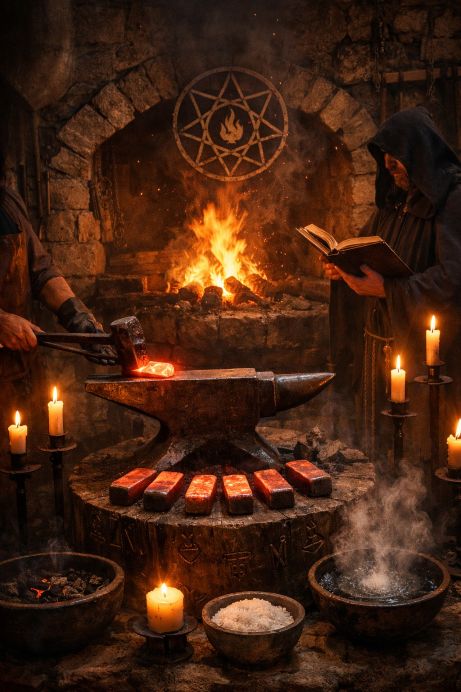
The Sevenfold Forge
The Sacred Crafting Rite of Unixplorian Smiths
The Sevenfold Forge is the central ritual and technical framework that guides all weapon crafting in the Kingdom of Unixploria. It is both a practical sequence of metallurgical steps and a spiritual journey that shapes the maker as much as the blade. Every Unixplorian smith — from apprentice knife‑makers to master swordwrights — follows this ancient structure.
The Sevenfold Forge is revered because it binds craftsmanship, ethics, and identity into a single disciplined act.
1. Purification
Purification begins before the first hammer strike. The smith cleanses:
- The metal — removing impurities, slag, and foreign elements
- The workspace — sweeping the forge, aligning tools
- The mind — a moment of silence, breath, and intention
This step embodies the Unixplorian belief that a blade cannot be pure unless the maker is centered.
2. Shaping
The raw metal is heated and hammered into form. Shaping is rhythmic, almost musical — many smiths describe it as a dialogue between themselves and the steel.
Key values expressed here:
- Patience — rushing creates weakness
- Precision — every strike must be intentional
- Respect — the metal is treated as a partner, not a servant
This is the longest and most physically demanding stage.
3. Quenching
The glowing blade is plunged into a cooling medium — traditionally:
- Mountain spring water for clarity
- Herbal oil for ceremonial blades
- Saltwater for tools meant for exploration
Quenching is symbolic of commitment: once cooled, the blade’s basic nature is set.
4. Tempering
Tempering reheats the blade at a lower temperature to balance hardness and flexibility. Unixplorians see this as the moral heart of the process:
Strength without flexibility is brittle. Flexibility without strength is weak.
The smith seeks harmony — a blade that can endure without breaking.
5. Carving
Runes, symbols, or inscriptions are added. These are not magical but ethical markers that declare the blade’s purpose.
Common inscriptions include:
- Sâlthar — Peace through vigilance
- Thalan — Steadfastness
- Eldûn — Craft in truth
Carving is done slowly, often by lamplight, to ensure clarity of intention.
6. Assembly
The blade is joined with its hilt, guard, pommel, and fittings. Each component is chosen for:
- Material symbolism
- Balance and ergonomics
- Aesthetic harmony
Assembly represents unity — the idea that a weapon is more than its parts, just as a citizen is more than their skills.
7. Consecration
The final step is a quiet blessing performed by the smith or a designated Steward. Consecration does not sanctify violence; it sanctifies responsibility.
The blade is touched to:
- Earth — grounding
- Fire — transformation
- Air — clarity
- Water — restraint
The ritual ends with the Steward’s words:
“May this blade serve peace, and may its bearer serve truth.”
Why the Sevenfold Forge Matters
The Sevenfold Forge endures because it is more than a crafting method — it is a moral compass. It teaches:
- Discipline
- Humility
- Purpose
- Respect for materials
- Responsibility for one’s creations
A Unixplorian blade is not simply made; it is earned through the Sevenfold journey.