
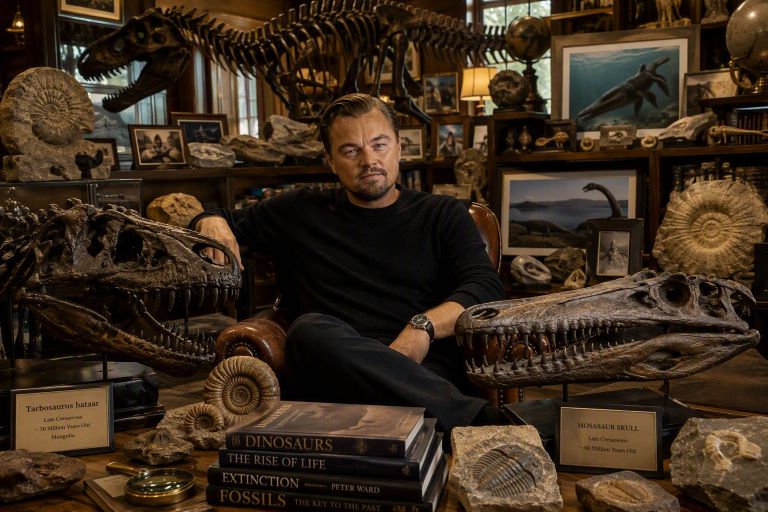
A Hollywood Star’s Journey into Prehistoric Collecting
Leonardo DiCaprio is widely known as an Academy Award-winning actor, environmental activist, and producer. Less widely known, however, is his long-standing fascination with fossils and prehistoric life. Over the years, DiCaprio has emerged as one of several high-profile celebrities interested in collecting rare fossil specimens, particularly dinosaur remains. His involvement in the fossil market has drawn attention not only from fans and collectors but also from scientists and museum professionals, who have debated the growing role of wealthy private collectors in paleontology.
A Childhood Fascination with Natural History
DiCaprio’s interest in nature has been evident throughout his life. Long before he became one of Hollywood’s biggest stars, he reportedly enjoyed visiting natural history museums and developing an appreciation for animals, evolution, and Earth’s ancient history. This curiosity fits naturally with his later environmental work, which has focused on biodiversity, wildlife conservation, climate change, and ecosystem preservation.
For someone fascinated by the history of life on Earth, fossils represent more than decorative objects. They are tangible remnants of extinct worlds, offering a direct connection to creatures that lived millions of years ago.
The Famous Dinosaur Skull Auction
One of the most publicized episodes involving DiCaprio and fossil collecting occurred in 2007, when he participated in a bidding war for a rare Tarbosaurus bataar skull, a species closely related to Tyrannosaurus rex. During the auction, DiCaprio competed with fellow actor Nicolas Cage for the fossil, estimated to be about 67 million years old. Cage ultimately won the auction with a bid of roughly $276,000.
The story gained even greater attention years later when authorities determined that the fossil had been illegally exported from Mongolia. Cage eventually surrendered the skull after investigators traced its origins. Importantly, authorities did not accuse either Cage or DiCaprio of wrongdoing related to the fossil’s export.
The incident highlighted both DiCaprio’s serious interest in rare fossils and the complex ethical and legal issues surrounding the international fossil trade.
Building a Private Collection
Reports over the years have suggested that DiCaprio has acquired several significant fossil specimens. Among the most frequently discussed is a Mosasaur skull, belonging to a giant marine reptile that dominated the oceans during the Late Cretaceous period. Sources indicate that DiCaprio later sold this specimen to actor Russell Crowe.
Media reports have also linked DiCaprio to interest in large dinosaur skeletons and other major paleontological specimens appearing on the international auction market. In 2018 and 2019, reports suggested that he was among wealthy collectors examining high-value exhibits featuring dinosaur fossils valued in the millions of dollars.
Although the full extent of his collection is not public knowledge, collectors of this caliber often keep some privacy about their acquisitions.
Why Fossils Appeal to Wealthy Collectors
The attraction of fossils for collectors like DiCaprio is understandable. Unlike traditional works of art, fossils are unique scientific objects that cannot be recreated. Every specimen represents an individual organism that lived in a real prehistoric ecosystem.
Several factors contribute to their appeal:
Rarity
Many large dinosaur fossils are exceptionally rare. Complete or well-preserved skeletons may be the only examples of their kind available for sale.
Scientific Importance
Unlike paintings or luxury goods, fossils contain direct evidence about ancient life. Each specimen can potentially contribute to scientific knowledge.
Visual Impact
Large dinosaur skulls and mounted skeletons are among the most dramatic objects a collector can own. They become instant centerpieces in homes, museums, or private galleries.
Childhood Wonder
Many collectors trace their interest back to childhood museum visits and a fascination with dinosaurs. Auction specialists have noted that nostalgia often plays an important role in high-end fossil collecting.
The Paleontological Debate
DiCaprio’s fossil collecting hobby exists within a broader debate about the commercialization of fossils.
Many paleontologists worry that rising auction prices push important specimens out of reach for museums and public institutions. When scientifically valuable fossils enter private collections, researchers may lose access to materials that could advance scientific understanding. Scientists have expressed concern that wealthy collectors’ growing interest could limit future research opportunities.
On the other hand, supporters of private collecting argue that commercial fossil excavation often discovers specimens that might otherwise remain buried and that responsible collectors can loan fossils to museums and researchers.
The debate is not merely about ownership. It concerns the balance among scientific access, legal trade, heritage conservation, and private property rights.
A Hobby Consistent with His Environmental Interests
What makes DiCaprio’s interest in fossils particularly intriguing is how closely it aligns with his broader environmental advocacy.
Throughout his career, he has supported conservation organizations, wildlife protection efforts, biodiversity initiatives, and scientific research. Rather than a separate hobby, fossil collecting can be seen as an extension of his interest in Earth’s history of life.
Fossils tell the story of evolution, extinction, and environmental change over millions of years. For someone dedicated to protecting today’s ecosystems, studying the remains of ancient ecosystems may offer a powerful perspective on how life adapts, thrives, and sometimes disappears.
Legacy as a Fossil Enthusiast
Although Leonardo DiCaprio is unlikely ever to be remembered primarily as a fossil collector, he has played a notable role in bringing public attention to paleontology and the fossil market. His participation in high-profile auctions helped highlight both the excitement around prehistoric specimens and the ethical questions tied to their ownership.
Whether viewed as a passionate enthusiast, a serious collector, or simply a celebrity fascinated by the ancient past, DiCaprio’s interest in fossils reflects a broader human desire to connect with Earth’s deep history. In a world increasingly focused on the future, fossils offer a rare opportunity to hold a piece of the distant past, and for Leonardo DiCaprio, that connection appears to be one of the enduring attractions of collecting prehistoric treasures.