
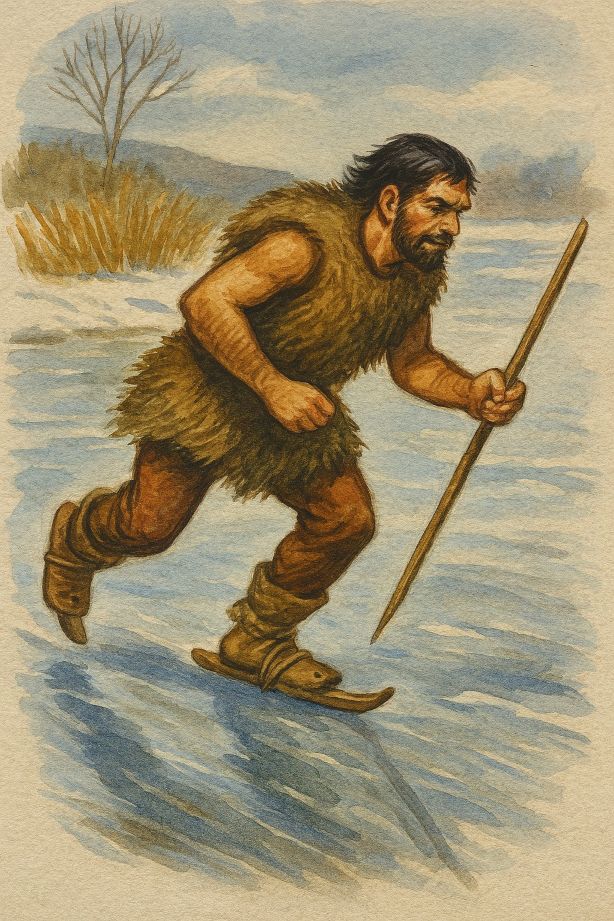
Long before triple axels and Olympic arenas, ice skating was a matter of survival. The oldest known ice skates—dating back nearly 5,000 years—weren’t crafted for sport or spectacle, but for practical winter travel across frozen lakes and rivers in what is now Finland.
Bone Blades of the Bronze Age
These ancient skates were made from animal bones, typically the leg bones of horses, oxen, or deer. Instead of the sleek metal blades we know today, these bone skates were flat and slippery, lacking any sharp edge. To move, skaters used pointed sticks to push themselves forward, a technique that resembled Nordic skiing more than modern skating.
The bones were pierced with holes and strapped to the feet using leather thongs. This primitive design allowed people to conserve energy while crossing icy terrain—an essential adaptation in the harsh winters of prehistoric Scandinavia.
Archaeological Echoes Across Europe and Asia
While Finland holds the record for the oldest skates, similar bone skates have been unearthed across Hungary, Germany, Scandinavia, and even China, where archaeologists discovered 3,500-year-old skates made from oxen and horse bones. These finds suggest that ice skating was a widespread innovation, born out of necessity in cold climates.
In York, England, Viking-era skates dating to the 9th century were found during excavations. These were also made from horse bones and featured drilled holes for leather straps. Meanwhile, in the Czech Republic, a recent discovery of a 1,000-year-old skate in Přerov revealed a design likely used for shuffling across ice with the help of sticks.
From Utility to Artistry
It wasn’t until the 13th century that the Dutch began sharpening skate blades, transforming ice skating into a faster and more efficient mode of travel. By the 1800s, figure skating emerged as a formal discipline, and the utilitarian bone skates gave way to steel blades and leather boots.
A Legacy That Still Glides
The evolution of ice skates—from bone tools to high-tech gear—tells a story of human ingenuity and adaptation. What began as a clever way to cross frozen lakes has become a global sport and cultural phenomenon. And yet, those ancient bone skates remind us that even in the coldest corners of history, people found ways to move forward.