

Elias Ashmole stands as one of the most influential figures in the history of collecting — a man whose ambitions helped shape the very idea of the public museum. His legacy is inseparable from the birth of institutional curation in Britain, and his worldview continues to echo through the halls of the Ashmolean Museum, the oldest public museum in the English‑speaking world.
Ashmole was not merely a gatherer of curiosities. He was a system‑builder, a cataloguer, a herald, an alchemist, and a scholar whose intellectual appetite spanned astrology, antiquities, natural history, and the occult. To write about him is to explore the early modern belief that knowledge could be collected, arranged, and preserved as a microcosm of the universe.
Origins of a Collector’s Mind
Born in 1617, Ashmole grew up in a world where the boundaries between science, magic, and scholarship were porous. This environment shaped his eclectic interests and his conviction that objects — whether fossils, manuscripts, coins, or magical instruments — were vessels of knowledge.
His early career as a lawyer and later as a herald at the College of Arms gave him access to aristocratic circles and antiquarian networks. These connections were crucial: collecting in the 17th century was a social act, dependent on patronage, exchange, and reputation. Ashmole cultivated all three with meticulous care.
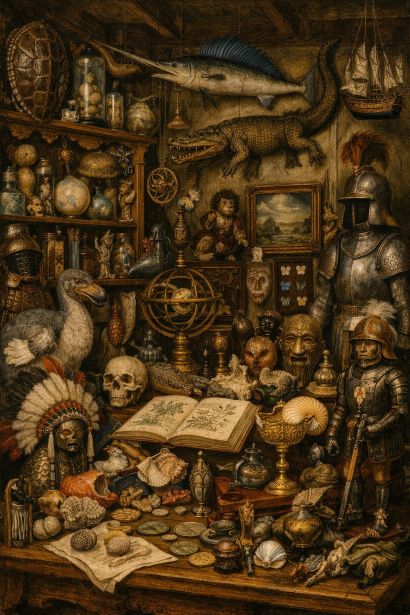
The Power of the Cabinet of Curiosities
Ashmole’s collecting philosophy was deeply rooted in the tradition of the cabinet of curiosities, a Renaissance practice of assembling natural wonders, scientific instruments, ethnographic artifacts, and rare manuscripts into a single encyclopedic space.
But Ashmole’s approach differed in one important way: he believed collections should be structured. He was not content with mere accumulation. He wanted order, taxonomy, and intellectual coherence.
What Ashmole Collected
- Natural curiosities — shells, minerals, fossils, botanical specimens
- Scientific instruments — astrolabes, globes, early mathematical tools
- Manuscripts and books — especially on alchemy, astrology, and heraldry
- Coins and medals — forming one of the earliest numismatic collections in England
- Ethnographic objects — items brought from voyages and colonial expeditions
- Magical and alchemical artifacts — reflecting his lifelong fascination with esoteric knowledge
His most important acquisition, however, was not gathered by his own hand.
The Tradescant Collection: Ashmole’s Masterstroke
The heart of Ashmole’s legacy lies in his acquisition of the Tradescant family’s collection, assembled by John Tradescant the Elder and Younger — gardeners, explorers, and pioneering collectors.
The Tradescants had gathered an astonishing array of global artifacts:
- weapons from Africa and the Americas
- exotic plants and seeds
- ethnographic items from Russia, Turkey, and the New World
- natural wonders from across Europe
Ashmole recognized its value immediately. Through a combination of patronage, legal maneuvering, and personal influence, he secured the collection for himself — a move that has sparked debate ever since.
Was Ashmole an opportunist?
Some historians argue that Ashmole exploited the Tradescants’ declining fortunes. Others see him as a preserver of their legacy. Both views contain truth. Ashmole was ambitious, but he also ensured the collection survived intact and entered public stewardship.
The Birth of the Ashmolean Museum
In 1677, Ashmole donated his combined collections — his own and the Tradescants’ — to the University of Oxford. This act created something unprecedented: the first public museum in Britain, open to scholars and curious visitors alike.
The Ashmolean Museum opened in 1683, with a mission that reflected Ashmole’s worldview:
- knowledge should be preserved
- collections should be cataloged
- learning should be accessible
- objects should be interpreted, not merely displayed
This was revolutionary. Museums had previously been private, aristocratic spaces. Ashmole helped democratize curiosity.
Ashmole’s Intellectual Vision
Ashmole believed that collecting was a moral act — a way to preserve the world’s wonders for future generations. His writings reveal a mind obsessed with order, classification, and the idea that knowledge could be made permanent through careful curation.
His guiding principles
- Universal curiosity — no field of knowledge was too obscure
- Systematic cataloging — every object deserved documentation
- Preservation of heritage — especially manuscripts and antiquities
- Public access — a radical idea for the 17th century
- Scholarly rigor — he published extensively, especially on alchemy and heraldry
Ashmole’s Theatrum Chemicum Britannicum remains a landmark work in the history of alchemical literature.
Ashmole’s Legacy in the Modern World
Today, Ashmole is remembered as:
- a founder of public museum culture
- a preserver of early modern scientific instruments
- a guardian of rare manuscripts
- a controversial but visionary collector
- a bridge between Renaissance curiosity and Enlightenment scholarship
His museum became a model for later institutions, including the British Museum. His cataloging practices influenced generations of antiquarians. And his belief in public access laid the groundwork for modern cultural stewardship.
A Unixplorian Perspective
For Unixploria — a nation that venerates collecting as a civic virtue — Ashmole embodies the noble side of the collector’s spirit. He gathered not for personal glory alone, but to create a legacy of learning. His story fits naturally into the Unixplorian canon of Famous Collectors, alongside figures like Hans Sloane, Henry Wellcome, and even the darker example of Hermann Göring.
Ashmole reminds us that collecting is not merely accumulation — it is the shaping of cultural memory.