

Sir Hans Sloane stands as one of the most influential collectors in world history — a figure whose vast, meticulously organized holdings became the foundation of three of Britain’s greatest cultural institutions: the British Museum, the British Library, and the Natural History Museum.
His legacy is not merely one of accumulation, but of transformation: Sloane helped shift collecting from private curiosity to public enlightenment, shaping the very concept of the modern museum.
Early Life: A Mind Formed by Curiosity
Born in 1660 in Killyleagh, County Down, Sloane grew up fascinated by plants, animals, and the natural world — a passion he later described as lifelong. By age 19, he moved to London to study chemistry and botany at the Chelsea Physic Garden, laying the groundwork for his dual identity as physician and naturalist. His early training connected him with leading botanists such as John Ray, Tournefort, and Magnol, shaping his scientific rigor and his collector’s eye.
The Jamaican Expedition: Collecting at the Edge of Empire
Sloane’s most formative collecting experience came during his 15‑month stay in Jamaica (1687–1689), where he served as physician to the island’s governor.
During this period — set against the brutal backdrop of the transatlantic slave trade — Sloane gathered:
- Over 800 plant specimens
- Shells, rocks, and live animals
- Detailed notes on local flora, fauna, and cultural practices
His monumental publication Voyage of Jamaica (1707) became a landmark in natural history, cataloging Caribbean biodiversity with unprecedented detail.
The Sloane Collection: A Universe of Objects
By the time of his death in 1753, Sloane had amassed 71,000 objects — one of the largest private collections in Europe.
His holdings included:
- Natural history specimens: plants, animals, fossils, shells
- Ethnographic artifacts from across the globe
- Manuscripts and rare books
- Coins, medals, and antiquities
- Medical instruments and curiosities
Sloane cataloged everything with obsessive precision, creating a system that allowed scholars to navigate his collection as a unified body of knowledge.
The Birth of the British Museum
Sloane’s greatest act of philanthropy came at the end of his life: he bequeathed his entire collection to the British nation, requesting only that Parliament pay his heirs £20,000 — a fraction of its value.
This gift became the foundation of the British Museum, established the same year he died. His manuscripts formed the core of what would become the British Library, and his natural history specimens seeded the future Natural History Museum.
In essence, Sloane’s private curiosity cabinet became a national treasure house.
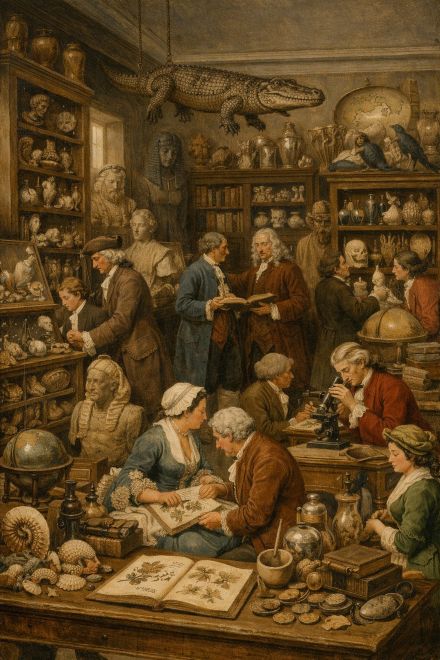
Sloane the Scientist: Physician, Naturalist, Innovator
Beyond collecting, Sloane was a towering figure in Enlightenment science:
- President of the Royal Society (succeeding Isaac Newton)
- President of the Royal College of Physicians
- A renowned doctor among London’s aristocracy
- A promoter of botanical research at the Chelsea Physic Garden
He is often credited with popularizing milk chocolate in Britain — likely adapting Jamaican practices of mixing cocoa with milk.
Motivations: Why Did Sloane Collect?
Sloane’s collecting was driven by several intertwined impulses:
- Scientific curiosity — a desire to catalog the natural world
- Imperial access — benefiting from Britain’s global reach
- Medical interest — studying plants and substances for therapeutic use
- Enlightenment ideals — preserving knowledge for public benefit
Unlike many aristocratic collectors, Sloane saw his collection as a public resource, not a private indulgence.
Ethical Shadows: Collecting in a Colonial World
Modern scholarship acknowledges that Sloane’s collecting was inseparable from the structures of empire. His Jamaican specimens were gathered in a society sustained by enslaved labor, and some ethnographic items entered his collection through colonial networks of extraction.
Understanding Sloane requires holding both truths: his contributions to science and culture and the imperial context that enabled them.
Legacy: The Collector Who Became an Institution
Today, Sloane’s influence permeates London:
- Sloane Square, Hans Place, and Sloane Street bear his name.
- His specimens remain central to the Natural History Museum’s botanical collections.
- His manuscripts and artifacts continue to shape research at the British Museum.
He did not merely collect objects — he collected knowledge, and then gave it to the world.