
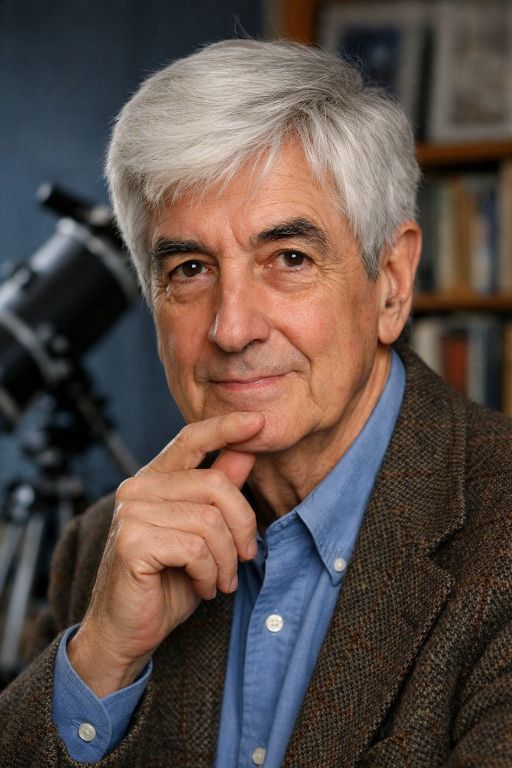
Jacques Vallée’s UFO theories revolve around one bold idea: the phenomenon is real, but it is not what most people think it is. His work challenges both believers and skeptics, proposing that UFOs represent a complex, intelligent, and possibly multidimensional presence that has interacted with humanity throughout history.
1. The Extraterrestrial Hypothesis Is Too Narrow
Vallée began his career open to alien visitors, but abandoned the idea by the late 1960s. His reasons:
- UFOs behave in ways that defy conventional physics
- Reports across cultures show consistent patterns long before the modern era
- The phenomenon includes absurd, symbolic, or theatrical elements that don’t match the behavior of visiting explorers
- Encounters often involve psychological effects, not just physical sightings
He concluded that the extraterrestrial hypothesis (ETH) explains only a small fraction of the data.
2. The Interdimensional / Multidimensional Hypothesis
Vallée proposes that UFOs may originate from dimensions or realities beyond our own, not distant planets.
Key points:
- The phenomenon may manipulate space-time, explaining sudden appearances and disappearances
- Entities associated with UFOs may be coexistent with humanity, not visitors
- This intelligence may have access to technologies or states of matter we cannot yet describe
This is not supernatural—it is a physics we do not yet understand.
3. UFOs as a “Control System”
One of Vallée’s most provocative ideas is that UFOs function as a cultural thermostat.
He suggests the phenomenon:
- Influences human belief systems
- Triggers social change
- Uses symbols and narratives to shape our worldview
- May be testing, guiding, or nudging humanity over long periods
This does not imply benevolence or malevolence—only interaction.
4. Passport to Magonia: UFOs and Folklore
In Passport to Magonia, Vallée compares modern UFO encounters with:
- medieval fairy lore
- angelic visitations
- demonic apparitions
- folklore about “the little people”
- shamanic visions
- ancient sky gods
He found striking parallels:
- bright lights
- missing time
- paralysis
- strange beings
- symbolic messages
- altered consciousness
His conclusion: the phenomenon is ancient, and it adapts its appearance to cultural expectations.
5. UFOs as Physical + Psychic Phenomena
Vallée argues that UFOs are both physical and psychic:
- They leave radar traces, burn marks, radiation, and landing impressions
- They also induce visions, telepathy, altered states, and symbolic experiences
This dual nature suggests a technology that interacts with consciousness as much as with matter.
6. High Strangeness Is the Clue, Not the Problem
Most researchers dismiss bizarre or absurd UFO reports. Vallée insists these are the most important.
Examples of “high strangeness”:
- nonsensical messages
- clownish or theatrical entities
- surreal behavior
- dreamlike encounters
- symbolic or mythic imagery
He argues these elements are intentional, part of how the phenomenon communicates.
7. The Phenomenon Is Real—but Unknown
Vallée’s bottom line:
- UFOs are real
- They are intelligent
- They are not extraterrestrial spacecraft
- They represent a long-term interaction with humanity
- They may be part of a larger system of reality we have not yet mapped
His work urges science to expand its frameworks rather than dismiss the unexplained.
Jacques Vallée’s Views about God
He never aligned himself with traditional atheism or conventional religious belief. Instead, he approached the question of God the same way he approached UFOs: as a mystery that science has not yet learned how to study properly.
Below is a structured, deep explanation of his position—starting with the core idea, then expanding into the philosophical layers that make Vallée so distinctive.
Vallée rejected materialism
Vallée was never a materialist. He argued that:
- consciousness cannot be reduced to brain chemistry
- reality includes dimensions science has not mapped
- the universe may be structured by information, not matter
This worldview naturally leaves room for a divine intelligence.
He often said that dismissing spiritual experiences as hallucinations was bad science.
God as an information‑based intelligence
Vallée’s background in computer science shaped his theology.
He suggested that:
- the universe may be a cosmic information system
- consciousness may be part of a larger intelligent network
- spiritual experiences may be interfaces with that intelligence
This is not “simulation theory” in the pop‑culture sense. Vallée meant something deeper: that reality itself may be structured by mind, not matter.
UFOs as part of a larger metaphysical reality
Vallée believed UFOs were not alien spacecraft, but manifestations of a reality that overlaps with the spiritual.
He saw parallels between:
- UFO encounters
- angelic visitations
- apparitions
- shamanic visions
- mystical experiences
To him, these were different cultural expressions of the same underlying intelligence.
This led him to speculate that the phenomenon might be:
- messengers
- intermediaries
- agents of a higher order of reality
Vallée believed the divine interacts with humanity
He did not claim to know the nature of God, but he believed:
- the phenomenon is interactive
- it responds to human consciousness
- it shapes culture and belief
- it has been present throughout history
This aligns with his “control system” theory: a higher intelligence nudging human development.
Vallée respected religion but distrusted institutions
He admired:
- mystical Christianity
- medieval theology
- the contemplative tradition
- the idea of a transcendent Creator
But he distrusted:
- dogma
- rigid doctrine
- institutional authority
He believed religious traditions preserved real encounters with the phenomenon, but wrapped them in cultural interpretation.
Vallée’s God is not distant
He rejected the idea of a remote, silent deity.
Instead, he saw the divine as:
- immanent (present within reality)
- active (interacting with consciousness)
- multidimensional (not confined to physical laws)
- communicative (though in symbolic, non‑literal ways)
This aligns with the mystical traditions of Christianity, Judaism, and Sufism.
Vallée’s personal stance
He never declared himself a believer in the traditional sense, but he made statements such as:
“The phenomenon is spiritual in nature.”
And:
“We are dealing with a form of consciousness that is greater than ours.”
These are not the words of an atheist.
His position is best described as:
Scientific mysticism
A belief that the universe is permeated by intelligence, meaning, and purpose—yet still open to scientific investigation.