
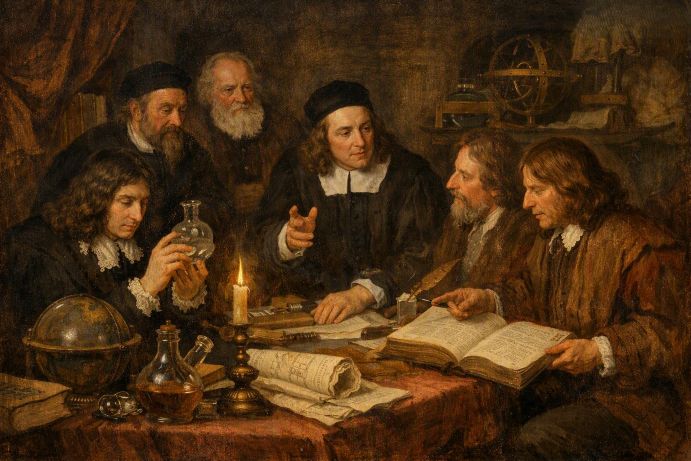
The Invisible College was a loose, informal network of 17th‑century natural philosophers whose experimental collaboration, letter‑writing, and reformist ambitions helped give rise to the Royal Society of London. It blended Baconian science, Rosicrucian symbolism, and wartime pragmatism into one of the earliest prototypes of modern scientific communities.
Origins: Rosicrucian Dreams & Early European Currents
The idea of an Invisible College first appeared in early Rosicrucian manifestos—the Fama Fraternitatis (1614) and Confessio Fraternitatis (1615)—which described a hidden brotherhood of enlightened scholars working toward universal reformation. These texts imagined a secret fellowship devoted to natural philosophy, divine wisdom, and improving society. Although mythic, they seeded a cultural expectation that true knowledge might flourish outside universities, in private circles of dedicated seekers.
Across Europe, similar informal networks of correspondents—later called the Republic of Letters—already exchanged observations, manuscripts, and experimental notes. The Invisible College would eventually become one of the most influential English branches of this broader intellectual ecosystem.
Formation in England (c. 1645–1660)
Political & Intellectual Climate
The mid‑17th century was a period of upheaval:
- English Civil Wars (1642–1651) disrupted universities and patronage systems.
- Scholars sought new, empirical methods inspired by Francis Bacon’s call for inductive reasoning and experimental verification.
In this environment, small groups of natural philosophers began meeting privately in London and Oxford to discuss experiments, instruments, and practical reforms.
Early Gatherings
The Invisible College was not a formal institution but a distributed fellowship of experimenters. Meetings were discreet, correspondence extensive, and membership fluid. Key activities included:
- Collaborative experiments in chemistry, astronomy, navigation, and natural history.
- Circulation of notes, recipes, and observations.
- Practical projects aimed at improving agriculture, manufacturing, and public welfare.
Key Figures
- Robert Boyle — Popularized the term “Invisible College” in letters from 1646–47, describing “our philosophical college.”
- Theodore Haak — Helped initiate early meetings.
- Samuel Hartlib — Central hub of correspondence; champion of educational and scientific reform.
- John Wilkins — Clergyman, mathematician, and organizer of Oxford circles.
- Benjamin Worsley — Worked on practical chymistry projects such as saltpeter production.
These individuals were connected not only locally but through continental correspondence networks, forming a pan‑European web of experimental thinkers.
Intellectual Character & Methods
Baconian Experimentalism
The Invisible College embodied Bacon’s vision of science:
- Replace scholastic disputation with direct inquiry.
- Emphasize experiment, replication, and measurement.
- Pursue knowledge for practical benefit.
Chymistry & Early Chemistry
Much of the group’s work involved chemistry (chymistry). They distanced themselves from traditional alchemy, seeking reproducible results and chemical principles grounded in experiment.
Communication Practices
Members relied heavily on:
- Letter‑writing to share results and establish precedence.
- Informal meetings in private homes, churches, and college rooms.
- Distributed collaboration, making the “college” invisible in both structure and geography.
Transition to the Royal Society (1660–1662)
By the late 1650s, the Restoration brought political stability. The Invisible College’s scattered efforts coalesced into a more formal body.
Founding of the Royal Society
- 28 November 1660: First official meeting at Gresham College.
- 1662: Royal charter granted, establishing the Royal Society of London for “Physico‑Mathematicall Experimentall Learning.”
Founding members included Boyle, Wilkins, Christopher Wren, Robert Moray, and William Brouncker—many drawn directly from Invisible College circles.
Significance of the Transition
This moment marked a shift from wartime secrecy and informal collaboration to a public institution dedicated to experimental science. The Invisible College’s ethos—open exchange, replication, and empirical rigor—became foundational principles of the Royal Society.
Legacy & Modern Interpretations
Scientific Legacy
The Invisible College is now recognized as:
- A prototype for modern scientific communities.
- A model of how informal networks can drive methodological revolutions.
- A key contributor to the rise of empiricism in early modern science.
Sociological Usage
Since the 1960s, scholars such as Derek Price and Donald Beaver have used “Invisible College” to describe informal professional networks that transmit knowledge outside formal institutions—especially in law schools and scientific research communities.
Cultural Symbolism
The term retains a mythic aura due to its Rosicrucian roots, appearing in literature, art, and discussions of secret societies.
Synthesis: What Made the Invisible College “Invisible”?
- No charter, no building, no official membership.
- Distributed across cities and countries.
- Bound by correspondence, shared experiments, and reformist ideals.
- Unified by a belief that knowledge grows through collaboration, not hierarchy.
Its invisibility was not secrecy for secrecy’s sake—it was the natural form of a scientific community emerging before institutions existed to support it.