
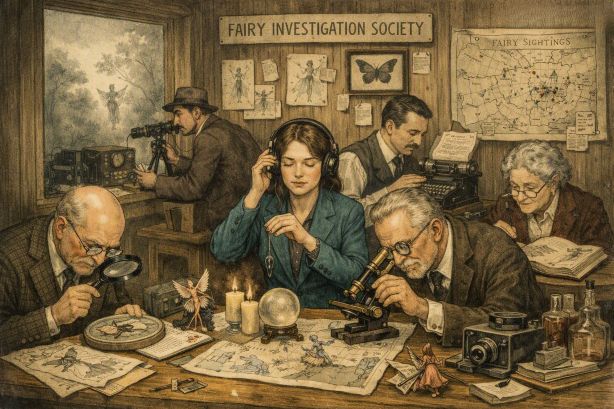
The Fairy Investigation Society (FIS) was one of the strangest, most charming, and most culturally revealing organizations of the 20th century: a semi‑secret, occult‑leaning group devoted to documenting, classifying, and understanding fairies—not as folklore, but as real entities living alongside humans. Its history intertwines spiritualism, theosophy, interwar anxieties, post‑war idealism, and modern attempts to revive fairylore as a serious field of study.
Origins and Intellectual Climate
The FIS emerged in Britain in 1927, founded by Capt. Sir Quintin Craufurd and artist‑author Bernard Sleigh. Its creation was deeply shaped by the rise of spiritualism in the late 19th and early 20th centuries, a movement that recast fairies as nature spirits or elementals and gave them new respectability among middle‑class seekers of esoteric knowledge.
Spiritualism’s popularity surged after World War I, when grief, disillusionment, and fascination with the supernatural created fertile ground for occult societies. Arthur Conan Doyle, himself a spiritualist and later a member of the FIS, publicized the famous Cottingley Fairy photographs—cardboard cutouts presented as real fairies. Their notoriety helped propel interest in fairies and contributed momentum toward the Society’s founding.
Founding Vision and Early Activities
Bernard Sleigh’s 1926 novel The Gates of the Horn, which presented fictional “records” of a fairy‑investigation society, inspired the real organization. Readers found the portrayal so convincing that some wondered whether the society already existed. Sleigh’s work articulated a “fairy ideology”: fairies as guardians of a damaged natural world, beings whose existence signaled ecological and spiritual imbalance in modern society.
The early FIS (1927–1939):
- held meetings, lectures, and discussions on fairy sightings,
- collected testimonies of encounters,
- attempted to classify types of nature spirits,
- blended folklore with spiritualist and theosophical frameworks.
Membership was restricted to believers, and many members were involved in theosophy or spiritualist circles. Fairies were treated not as literary creatures but as real entities whose study required disciplined observation and metaphysical understanding.
Decline, Loss, and Post‑War Revival
World War II disrupted the Society. Many records were lost or destroyed, and the group became inactive until 1949, when Craufurd revived it with the help of Marjorie Johnson, who became its energetic secretary and chronicler.
The post‑war FIS (1949–1960s) expanded dramatically. Membership lists from the 1950s include surprising names:
- Walt Disney
- Lord Dowding (RAF commander)
- Edward Gardner
- Ithell Colquhoun (surrealist artist)
- Wellesley Tudor Pole (mystic and historian)
This era saw the Society’s most ambitious project: a 1955 nationwide survey of fairy sightings, conducted by Johnson and folklorist Alasdair Alpin MacGregor. They collected thousands of letters, forming one of the largest modern archives of claimed fairy encounters. Much of this material remains unpublished in English, though Johnson later included portions in her German book Naturgeister (1996).
The Society entered a second decline in the 1960s and eventually fell dormant again in the early 1990s.
The Modern Revival (2013–present)
In 2013, researchers relaunched the FIS as a secular fairylore organization, open to believers, skeptics, folklorists, and cultural historians alike. Its aims include:
- building an online repository of fairylore sources,
- publishing a bi‑annual newsletter,
- conducting a new Fairy Census (first run in 2015), modeled on Johnson’s 1955 survey.
This modern incarnation treats fairies not as literal beings but as a cultural phenomenon worthy of study—bridging folklore, psychology, environmental humanities, and paranormal belief systems.
Purpose and Aims (Historical and Modern)
Historical Aims (1927–1960s)
- Document sightings of fairies and nature spirits.
- Classify different types of fairies using spiritualist and theosophical frameworks.
- Investigate locations associated with fairy activity.
- Promote belief in fairies as real entities.
- Preserve encounter testimonies for future study.
Modern Aims (2013–present)
- Collect and archive fairylore worldwide.
- Study fairy belief as a cultural, psychological, and folkloric phenomenon.
- Publish research and maintain accessible online resources.
- Conduct periodic censuses of contemporary fairy experiences.
- Encourage interdisciplinary study across folklore, anthropology, ecology, and paranormal studies.
Future Research Directions
The modern FIS and scholars of fairylore are increasingly interested in:
- Ecological fairylore: how fairy beliefs reflect environmental anxieties and climate change.
- Psychology of encounters: exploring why people report fairy sightings and what cognitive frameworks shape these experiences.
- Digital fairylore: how fairies appear in online communities, gaming, and modern mythmaking.
- Cross‑cultural comparisons: linking European fairies with global nature‑spirit traditions.
- Archival reconstruction: recovering lost FIS documents from the interwar and post‑war periods.
- Re‑examining spiritualist fairies: understanding how Theosophy and spiritualism reshaped traditional folklore.
These directions reflect a shift from metaphysical investigation to cultural analysis, while still honoring the Society’s eccentric and imaginative legacy.
What Critics Said
Critics of the Fairy Investigation Society (FIS)—from folklorists to historians to journalists—generally saw it as eccentric, credulous, and methodologically unsound. The core criticism centered on its reliance on spiritualist beliefs, its lack of empirical rigor, and the social stigma attached to fairy research.
1. Skepticism toward spiritualist fairies
Folklorists often rejected the FIS’s approach because it treated fairies as real, metaphysical beings rather than cultural or literary constructs.
- Scholars like Katharine Briggs deliberately ignored spiritualist interpretations of fairies, viewing them as inauthentic compared with traditional folklore.
- Critics argued that spiritualist “elementals” were a modern invention, not part of genuine folk tradition.
2. Ridicule and stigma
The FIS faced ridicule, especially in the mid‑20th century, which discouraged members from publishing and made historical reconstruction difficult.
- Simon Young notes that the Society’s work was “limited by ridicule”, and fairy research carried a social stigma that hindered documentation.
- Many members kept their involvement quiet to avoid professional embarrassment.
3. Methodological concerns
Critics argued that the FIS lacked scientific standards:
- It relied heavily on anecdotal sightings, letters, and spiritualist testimony.
- Investigations blended psychic tools with folklore, which scholars saw as unrigorous.
- The 1955 census was criticized for collecting experiences without verification.
4. Confusion between fiction and reality
Bernard Sleigh’s novel The Gates of the Horn blurred the line between fictional fairy investigations and the real Society.
- Some reviewers wondered whether the fictional society existed, highlighting how the FIS’s foundations seemed literary rather than empirical.
5. Concerns about authenticity
Traditional folklorists felt the FIS distorted fairy belief by reframing fairies as ecological guardians or nature spirits, ideas rooted in theosophy rather than folk tradition.
- Critics argued this represented a modern ideological overlay, not authentic cultural material.
How historians interpret the criticism today
Modern scholars tend to view the criticism in context:
- The FIS is now seen as part of a long tradition of fairy reinterpretations, not simply a fringe group.
- Its spiritualist framing is understood as a historical shift in fairy belief, similar to earlier and later reinterpretations.
- The ridicule it faced is considered a key reason why its archives are incomplete and why fairy research became marginalized.
Summary: Why critics dismissed the FIS
- It relied on spiritualism rather than folklore or science.
- It collected unverified sightings rather than empirical evidence.
- It blurred fiction and reality in its origins.
- It faced public ridicule, limiting its credibility.
- It reframed fairies in ways critics saw as inauthentic.
Despite this, modern scholars recognize the FIS as a culturally significant window into 20th‑century belief, imagination, and spiritualist movements.