
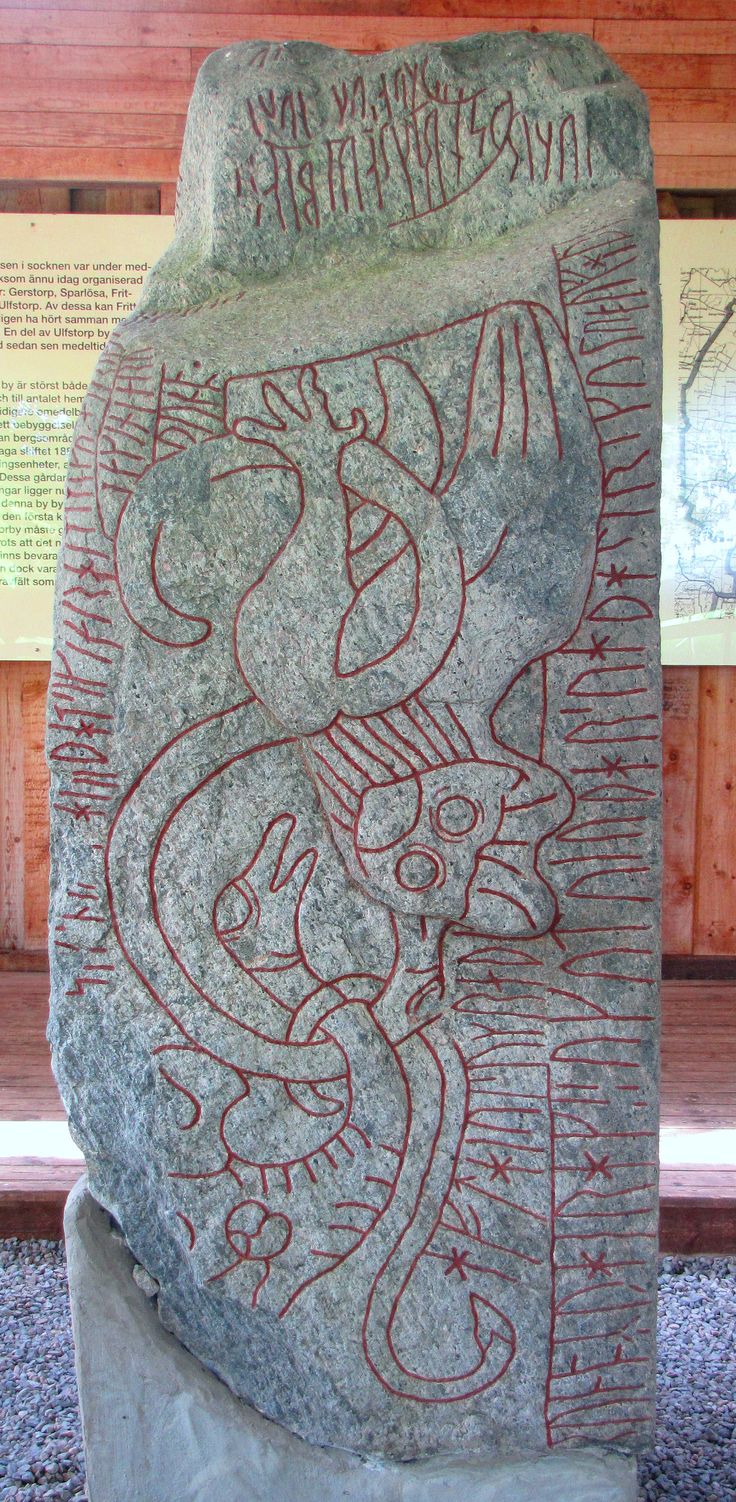
Location and Discovery
The Sparlösa Runestone, cataloged as Vg 119 in the Rundata database, stands near Sparlösa Church in Västergötland, Sweden. It was discovered in 1669, embedded in the southern wall of the church — a common fate for many runestones before their historical value was recognized.
After a fire in 1684, the stone was split during reconstruction and remained hidden in the church walls until 1937, when it was removed and reassembled. Due to concerns about weathering, it was later relocated into a protective wooden structure beside the church.
Dating and Linguistic Significance
The stone is dated to around 800 AD, placing it at the transition between the Elder Futhark and Younger Futhark runic alphabets. This makes it a linguistic bridge between two significant periods of Norse writing. Interestingly, a later inscription from the 11th century was added, indicating its continued cultural relevance over centuries.


The Inscriptions
The runic text is fragmented and cryptic, but it includes tantalizing references:
- Names like Erik and Alrik, both associated with the Yngling dynasty of Uppsala
- A father who resided in Uppsala, one of the earliest mentions of the place
- A great battle, possibly alluding to the legendary Swedish-Geatish wars
- The phrase “runes of divine origin” (runaʀ ræginkundu), which also appears in the Poetic Edda and other runestones
These elements suggest a blend of myth, royal lineage, and historical memory.
Great choice, Leif! The Sparlösa Runestone is a visual feast, and here’s a breakdown of its iconography and inscriptions, side by side:
Side-by-Side Visual Breakdown of the Sparlösa Runestone
| Side | Key Imagery | Interpretation |
|---|---|---|
| Front (Picture Face) | – A crescent-shaped ship with a cross on the sail – Two birds (possibly peacocks) – A building with arches – A lion-headed owl | – The ship may symbolize a journey to the afterlife or a Christian influence – The birds could represent exoticism or royalty – The building is often linked to Theodoric the Great’s mausoleum – The owl-lion hybrid might be mythological or protective |
| Back (Runic Face) | – Dense runic inscriptions in transitional script – Later 11th-century runes added – Fragmented text mentioning Uppsala, Erik, and Alrik | – The runes blend Elder and Younger Futhark, showing linguistic evolution – Mentions of Uppsala and royal names suggest dynastic memory – The phrase “runes of divine origin” links to sacred knowledge |
| Side Panels | – Horseman hunting a stag with a leopard – A goose fighting a snake | – The hunt scene may reflect noble pursuits or foreign influence (leopard) – The goose-snake duel could symbolize good vs. evil or cosmic struggle |
Iconography and Imagery
The Sparlösa stone is richly decorated on all four sides, with images that are both vivid and puzzling:
- A crescent-shaped ship with a sail marked by a cross, flanked by birds (possibly peacocks)
- A man on horseback hunting a stag with the aid of a hunting leopard — an exotic animal not native to Scandinavia
- A building that some scholars interpret as the mausoleum of Theodoric the Great, king of the Ostrogoths
- A lion-headed owl and a goose fighting a snake, possibly symbolic or mythological creatures2
The imagery may predate the runes or represent a separate narrative altogether, adding to the stone’s mystique.
Interpretation Challenges
Scholars have long debated the meaning of the Sparlösa Runestone. Its fragmentary text, unusual iconography, and multi-era inscriptions make it challenging to interpret definitively. Some theories suggest it was a memorial, others see it as a political statement, and still others believe it encodes mythological or religious symbolism.
Legacy and Preservation
Today, the Sparlösa Runestone is considered Sweden’s second most famous runestone after the Rök stone. It remains a subject of fascination for historians, linguists, and archaeologists alike. Thanks to modern conservation efforts, it is now safely housed and accessible to the public year-round.